Key points
- You don't need to be fit or flexible to start. healthdirect notes Pilates suits all fitness levels, and instructors adjust every move.
- The genuinely hard parts are deep core control, precision, and focus, not strength or speed.
- A first class feels awkward. By week 4 the cues make sense. Around week 6 to 8 the control becomes available.
- The difficulty scales with you. It stays a bit hard on purpose, just never the kind of hard that locks a beginner out.
Is Pilates hard for a complete beginner?
Not in the way you're picturing. Most nervous beginners imagine they'll be the unfit person who can't keep up, exposed in a room full of bendy regulars. Pilates is built around control and breathing rather than speed or strength, and a good beginner class starts everyone at the same low-load place.
What catches people off guard is that the difficulty is internal. There's no sprint, no heavy barbell, nothing that looks dramatic from the outside. Then the instructor asks you to draw your lower belly in, keep breathing, and move one leg slowly, and you realise how little of that you control on the first go. The challenge is fine motor control and attention, not raw effort. That's a different muscle, mentally and physically, than most exercise trains, which is exactly why it feels unfamiliar at first.
Australia's national health service, healthdirect, puts the entry point plainly: instructors "can adjust yoga and Pilates moves to suit all ages and fitness levels," and beginners should "start slowly and practice regularly," focusing on learning each move properly before doing more. A studio that runs a real beginners' class is set up for the exact person who's worried they can't do it.
What's actually hard about Pilates
The genuinely hard parts are control, precision, and focus, in that order. None of them are about being strong or fit. They're about doing small things accurately while your body would much rather cheat.
Deep core control is the first wall. Pilates asks you to engage the muscles deep in your trunk, the ones wrapped around your spine and lower abdomen, and keep them switched on while the rest of you moves. Most people have spent years letting bigger surface muscles do that job, so learning to find and hold the deep ones feels strange and tiring. You'll shake. That's normal, and it's the work.
Precision is the second. A Pilates movement done well is small, slow, and exact, and the instructor will keep refining it long after you think you've got it. Lower the leg two centimetres less. Keep the ribs down. Stop the shoulders creeping up. The corrections never quite stop, because precision is the whole point, and a sloppy big movement is worth less here than a tiny controlled one. For a lot of people used to "more reps, more weight," that reframe is the hardest part.
Focus is the third, and the most underrated. A class is forty-five to sixty minutes of paying attention to your own body, breath by breath. There's nowhere to zone out. If your mind wanders, the movement falls apart, which is its own kind of demanding when you're used to exercise you can switch off through.
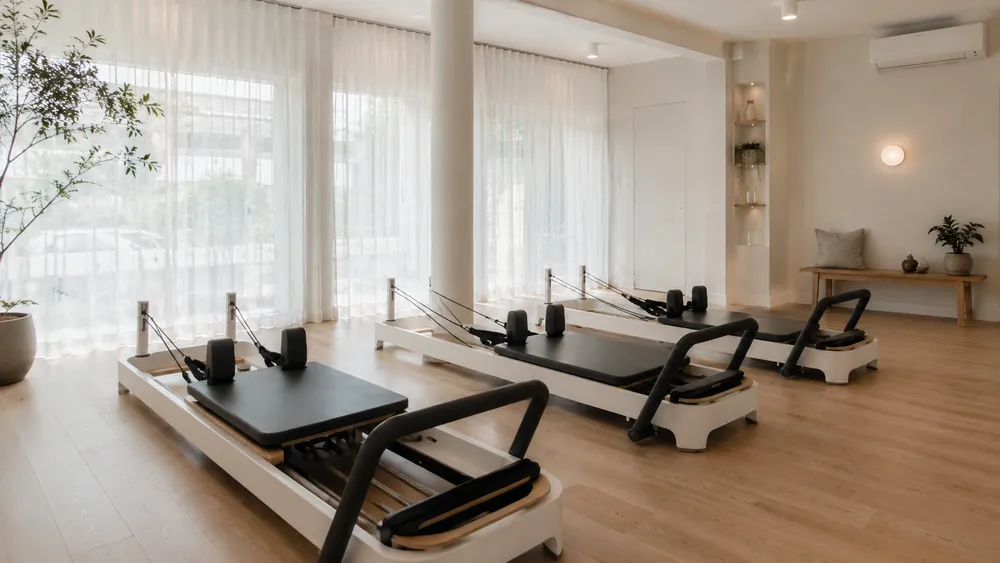
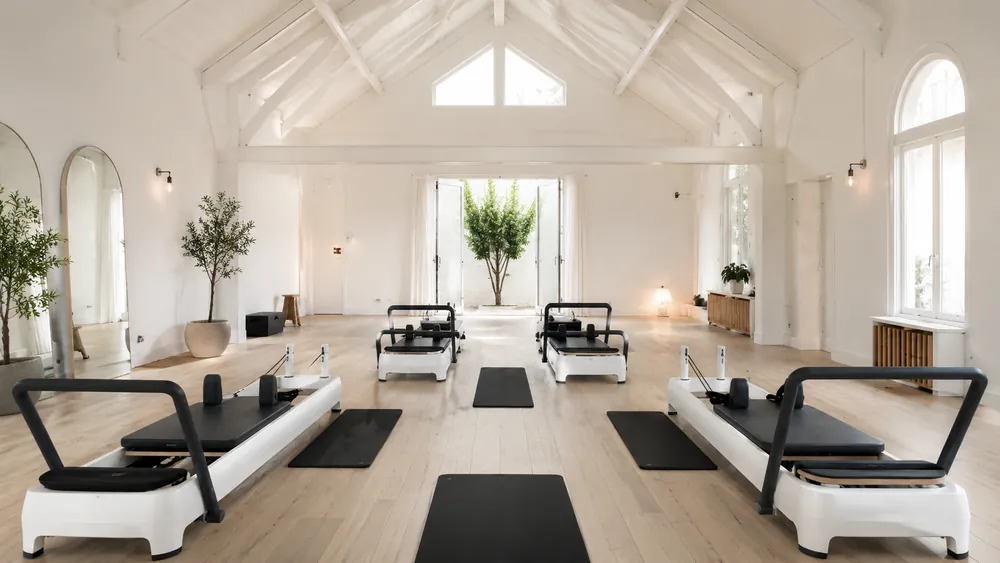
On the reformer, add coordination. The carriage slides, the springs change the load, and you're managing your hands, feet, and breath on a moving surface. That's a real learning curve in the first couple of classes, and it has nothing to do with fitness. It's just new, the way driving a manual car is new. Our guide on what to expect in your first reformer class walks through the setup so the machine feels less foreign on day one.
What's not hard (and what you don't need)
You do not need to be fit to start, and you do not need to be flexible. Both of those are outcomes of Pilates, not entry requirements, and believing otherwise keeps people on the couch for months for no reason.
Take fitness first. Pilates is low-impact and starts at low load. You're not running, jumping, or lifting anything heavy in a beginners' class. healthdirect lists Pilates as suitable across "all ages and fitness levels," and a beginner with no exercise base can do a foundations class safely. You'll be tired in a focused, worked way afterwards, not wrecked.
Flexibility is the bigger myth, and it's worth killing properly. You don't have to touch your toes to begin. The movements are designed to build flexibility over time, not to test it on arrival, and instructors hand you modifications and props so a stiff body does the same exercise safely. We cover this in full in our guide on whether you need to be flexible to start, but the short version is no. Tight hips and hamstrings are the normal starting point, not a disqualifier.
You also don't need to look a certain way or be a certain size. Pilates works for a wide range of bodies, and a good studio modifies for whoever walks in. If that's a specific worry, our plus-size Pilates guide covers finding a studio and an instructor who get it right.
What you actually need is short: clothes you can move in, grippy socks if it's a reformer or mat studio that requires them, and a willingness to be a beginner for a few weeks. That's the real list.
Is reformer Pilates harder than mat?
They're hard in different ways, and neither is the obvious "advanced" option. Reformer adds a machine and spring load; mat strips everything back to your own body weight. Which feels harder depends on what trips you up.
Reformer can feel more intimidating before you start, because there's equipment to learn. Once you're on it, the springs can actually make some movements easier, supporting you through a range you'd struggle with on the floor. The flip side is the coordination cost in those first classes, plus the spring resistance loading your muscles harder when the instructor wants it to. Reformer tends to build visible strength a bit faster for that reason.
Mat looks gentler and often isn't. With no spring to assist you, there's nowhere to hide. You either control the movement with your own core or you wobble, and a well-taught mat class exposes weak technique fast. Plenty of people are surprised by how demanding a "just a mat" class turns out to be.
For a true beginner, the honest answer is that either works if you start in a beginners' class. Reformer needs a quick safety briefing on the machine; mat needs none. If you're weighing the two, our full reformer vs mat Pilates comparison breaks down cost, class size, and which suits how you like to learn.
How Pilates feels in week 1 vs week 4 vs week 8
It gets noticeably easier, and the change is mostly in your control and confidence rather than raw strength. Here's the rough arc most beginners describe, framed as typical experience rather than a guaranteed timeline.
| Timeframe | What it feels like | |---|---| | Week 1 | Cues don't make sense yet; you're a beat behind the class; you finish unsure if you did any of it right. Deep abdominal soreness the next day: muscles you didn't know existed. Don't judge Pilates at week 1. | | Week 4 | The vocabulary lands. "Engage your core," "neutral spine," "breathe into your back" stop being noise and become instructions you can follow. You're keeping up and you've stopped bracing against the whole experience. | | Week 6 to 8 | A real shift. The control that was impossible in week 1 starts to feel available. Deep core engagement holds longer, precision comes more naturally, and you spend less of the class fighting your own body. |
The pattern underneath all of it: the difficulty doesn't disappear, it moves. As control gets easier, the instructor adds load, range, or complexity, so the class stays challenging at a level that matches you. That's the point. It's supposed to keep being a bit hard, just never the kind of hard that locks a beginner out. If you want the detailed week-by-week version, our Pilates results timeline guide goes deeper.
Why "is Pilates hard" is the wrong question
Underneath the "is it hard" question is usually a fear of being incompetent in front of people, of being the one who can't do it. And that specific fear is the one Pilates is gentlest on.
Because the work is internal and low-impact, nobody in the room is watching you. They're all deep in their own deep-core struggle, breathing and shaking and getting corrected, same as you. The instructor's job is to walk over and adjust you, not to judge you, and telling them at the start that you're new makes the whole hour easier. If first-class nerves are the real blocker, our guide on handling first-class anxiety covers the opening conversation and what actually happens when you walk in.
Pilates scales. The same exercise can be made easier or harder by changing a spring, a lever length, or a range of motion, which is exactly why one class can hold a nervous first-timer and a ten-year regular at once. You won't be doing the regular's version, you'll be doing yours.
The only real way to find out where you land is to book a beginners' class and go.
If you're ready to start, browse Pilates studios near you and look for one that runs a dedicated beginners' or foundations series, or search Studio Finder for a beginner-friendly class.
This guide is general information only and is not medical advice. See your GP or an allied health professional for advice about your own situation.
Is Pilates Hard? An Honest Beginner Guide: common questions
- Is Pilates hard if you're really unfit?
No harder than it is for anyone else starting out, as long as you pick a beginners' class. Pilates is low-impact and starts at low load, and healthdirect lists it as suitable for all fitness levels. You'll work, and you'll be sore in the deep core afterwards, but an unfit beginner can do a foundations class safely. Tell the instructor you're new so they can adjust the moves for you.
- Is reformer Pilates hard for beginners?
The machine adds a short learning curve in the first couple of classes, mostly around coordinating your movement on a sliding carriage and managing the spring settings. That part is new rather than physically hard. Good studios run a beginner briefing or a dedicated beginners' series so you're not learning the reformer cold. After two or three classes the setup stops feeling foreign.
- How long until Pilates stops feeling hard?
For most beginners, the class feels far less hard by around week 4, once the cues make sense and you can follow along, with a bigger shift in control around the six-to-eight-week mark of consistent practice. This is typical experience, not a fixed rule, and it depends on how often you go. The difficulty never fully disappears, because the work scales up as you improve.
- Do I need to be flexible to start Pilates?
No. Flexibility is something Pilates builds, not something you need first. The movements are designed to improve flexibility over time, and instructors offer modifications and props so a stiff body can do the same exercise safely. Tight hamstrings and hips are the normal starting point. Our guide on whether you need to be flexible to start covers this in full.
- Will I embarrass myself in my first Pilates class?
Almost certainly not. The work is internal and low-key, so nobody is watching you, and everyone in the room is occupied with their own movement. The instructor expects beginners and is there to help. Letting them know it's your first class is the single best thing you can do to make the hour easier. Our first-class anxiety guide covers what actually happens.
- Is mat Pilates easier than reformer?
Not necessarily. Mat looks gentler because there's no equipment, but without the springs to assist you, every movement relies on your own control, which can make a mat class quietly demanding. Reformer adds load and coordination but can also support you through harder positions. For a beginner, both work if you start in a beginners' class.
Ready to find a studio?
Compare pilates studios across Australia. Filter by location, read real reviews, and enquire direct.