Key points
- Pick the right format first. Hatha, Slow Flow, or Beginners Flow are the right first classes, not hot, power, or Ashtanga.
- Flexibility is not required. Beginners with tight hips and hamstrings are the normal starting point, not the exception.
- Savasana (lying flat at the end) is part of the practice, not a rest break. Stay for it.
- Once a week maintains; twice a week is where the practice builds.
Yoga formats: which one to start with
For a first class, pick Hatha, Slow Flow, Beginners Flow, or Foundations. Save the rest until you know what you like. Here is what each of the common Australian studio formats involves. Hatha is the classic entry point: slow-paced, one pose held for several breaths at a time, with detailed cueing. It is often the format taught in Beginner Series or Foundations classes. A Slow Flow or Beginners Flow adds breath-led movement at a gentler pace and works just as well for a first class. Regular vinyasa links movement to breath at a faster clip, with the transitions between poses part of the work. It builds heat and is harder than it looks, so save it unless the class is labelled level 1 or slow.
At the quiet end sit yin and restorative. Yin holds passive floor poses for three to five minutes each, working into the fascia and connective tissue rather than the muscles, and it is slower and quieter than a lot of people expect, sometimes surprisingly emotional too. It is good for the kind of stiffness a desk job gives you, though do not expect much of a cardio workout. Restorative goes slower still: poses are propped up with bolsters and blankets and held for five to ten minutes. It is closer to meditation than exercise, good for stress, bad sleep, or those weeks when you just need to recover.
Power yoga is vinyasa-derived but more athletic and often heated. It is workout-focused, so skip it for a first class unless you have done yoga before. Hot yoga means any class in a heated room, and the heat changes the experience meaningfully. Bikram, the most rigid version, is a fixed series of 26 postures (24 asanas and two breathing exercises) practised for 90 minutes in a room heated to 40°C with about 40 percent humidity, per the Bikram Yoga overview on Wikipedia. An acquired taste either way; the hot yoga guide covers the heated styles properly.
That leaves the two outliers. Ashtanga runs a set sequence at a fast pace, traditionally self-led in "Mysore" style once you have learned it, and is not beginner-friendly. Kundalini is heavier on the spiritual side, with breath work, chanting, and meditation alongside the physical practice. Worth knowing what you are walking into, because the contemplative content is more prominent than in other formats.
| Format | Pace | Best for a first class? |
|---|---|---|
| Hatha | Slow, one pose at a time | Yes: ideal first class |
| Slow Flow / Beginners Flow | Moderate, breath-led movement | Yes: good entry point |
| Vinyasa (regular) | Moderate to fast | Only if labelled level 1 or slow |
| Yin | Slow, long passive holds | Fine: very different feeling |
| Restorative | Very slow, fully supported | Fine: meditative, not a workout |
| Power yoga | Fast and athletic | Skip for first class |
| Hot yoga / Bikram | Heated room, intense | Skip for first class |
| Ashtanga | Fixed sequence, fast | Not beginner-friendly |
| Kundalini | Spiritual focus, chanting | Know what you are walking into |
The typical structure of a first beginner class
A 60-minute Hatha or Beginners class in Australia follows roughly this shape.
Minutes 0 to 5: settling. Sitting on your mat with eyes closed or soft. The instructor introduces the class, sets an intention, and sometimes guides a few rounds of breath work. This settling-in ritual is particular to yoga; you will not usually get it in a Pilates or barre class. If you came in expecting to "just exercise," this opening can feel slow. Stay with it.
Minutes 5 to 15: warm-up. Gentle mobility on the mat: cat-cow, gentle twists, side stretches. Then sun salutations or a simplified flow you will repeat three to five times. The instructor walks you through each pose the first time.
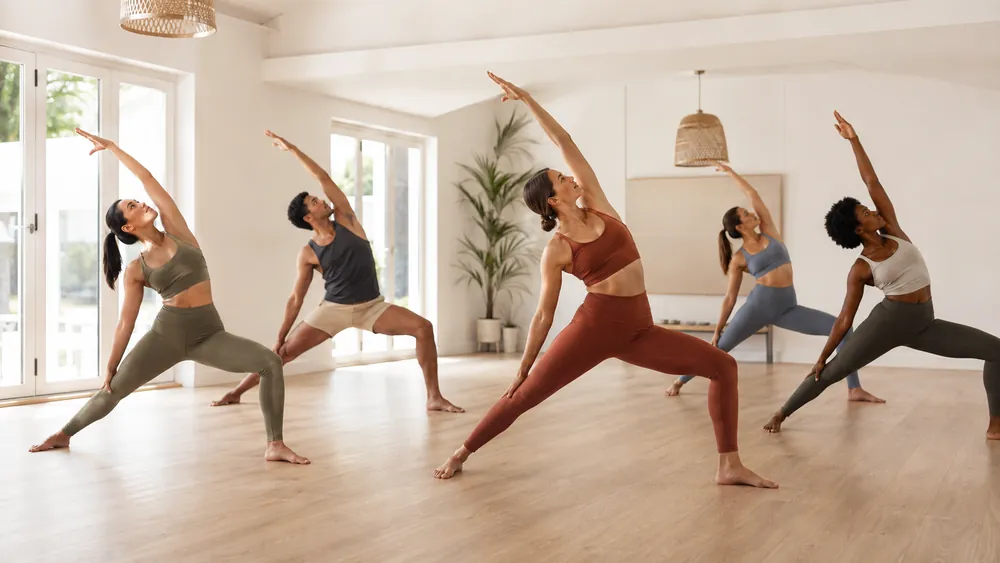
Minutes 15 to 40: standing poses. Warriors I, II, and III, triangle, side angle, half-moon, tree. The instructor cues alignment in detail and offers modifications. You will be encouraged to take a less-deep version of any pose if you need to, and you will feel the muscles in your hips, shoulders, and standing leg.
Minutes 40 to 50: floor poses and gentle inversions. Pigeon for the hips, bridge or shoulder stand for the back and core, sometimes a forearm balance attempt. Beginner classes do not include headstands or handstands.
Minutes 50 to 58: closing stretches. Forward folds, supine twists, knees to chest, hamstring stretches.
Minutes 58 to 60: savasana. Lying flat on your back, eyes closed, doing nothing for several minutes. This is a deliberate part of the practice, not a rest break. The instructor guides you in and out. A lot of beginners find savasana harder than the standing poses. Stay with it.
A 75-minute class adds time to the standing poses and closing stretches; a 90-minute beginner class is rare.
- 0 to 5 minSettling. Sitting on your mat with eyes closed or soft while the instructor sets an intention and sometimes guides a few rounds of breath work.
- 5 to 15 minWarm-up: gentle mobility on the mat (cat-cow, gentle twists, side stretches), then sun salutations or a simplified flow repeated three to five times.
- 15 to 40 minStanding poses: warriors I, II, and III, triangle, side angle, half-moon, tree, with detailed alignment cues and modifications offered.
- 40 to 50 minFloor poses and gentle inversions: pigeon for the hips, bridge or shoulder stand for the back and core. No headstands or handstands in beginner classes.
- 50 to 58 minClosing stretches: forward folds, supine twists, knees to chest, hamstring stretches.
- 58 to 60 minSavasana. Lying flat on your back, eyes closed, for several minutes. This is a deliberate part of the practice, not a rest break.
What you will feel during the class
The stretching finds places you did not know were tight. Hip flexors, glutes, shoulders, hamstrings, the muscles around the shoulder blades. If you sit at a desk most days, there is a good chance you are tight in spots you have not noticed, and yoga tends to find them fast.
Holding warrior II for thirty seconds is harder than it looks, especially if you have spent the day at a desk. Ninety seconds is harder again. That is real strength being built in your legs, core and shoulders, even though it does not feel like a conventional workout.
And at some point the breath takes over. The instructor cues every move off it: inhale to extend, exhale to deepen. After a few classes, you notice your own breath has gone shallow and reset it without thinking. That habit often carries over outside the studio, which can catch you by surprise.
What to wear and what to bring
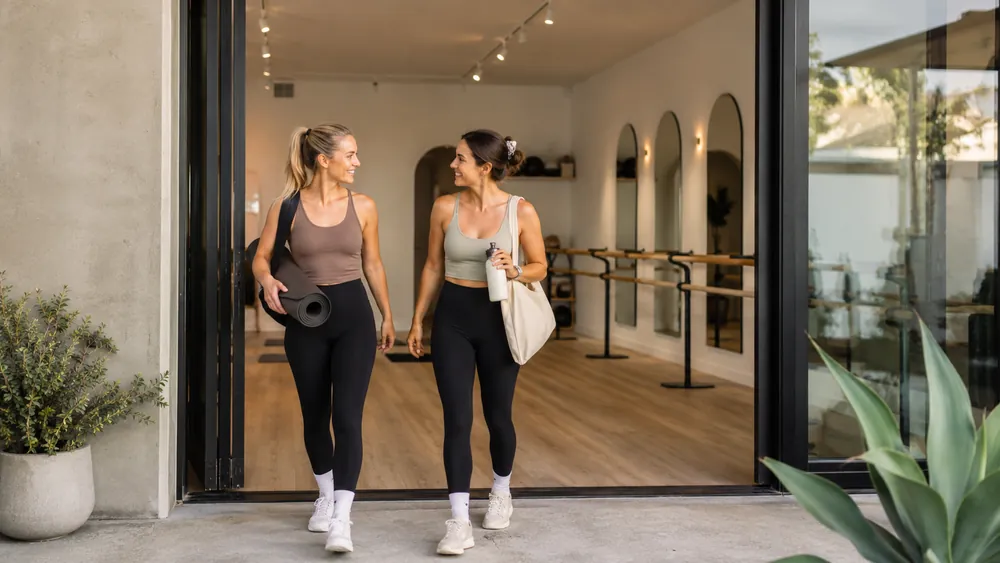
The packing list is short, and most of it is about staying comfortable in poses you have not met yet.
- Fitted activewear. Loose tops fall over your face in inversions and forward folds. Loose bottoms hide your alignment.
- Bare feet, no socks. Yoga is practised barefoot. If you would rather not stand barefoot on a mat other people have used, bring your own mat.
- A mat if you have one. Most studios lend or rent for a few dollars. If you are going to make this a habit, your own mat from any sports retailer is worth it.
- A water bottle. Studios usually have refill stations. Most people do not drink during an unheated class, and heated studios set their own protocol, with some teachers asking you to wait for a designated break.
- Phone in the locker. Yoga studios are particularly strict about this; the silence is part of the practice.
Leave at home: heavy fragrance (the room is enclosed and people will notice), a heavy meal in the previous two hours (twists and forward folds are unpleasant on a full stomach), and any expectation that you will be flexible. Flexibility is what yoga builds. You do not need it to start.
Checklist
- Fitted activewear; loose tops fall over your face in inversions and forward folds.
- Bare feet, no socks; yoga is practised barefoot. Bring your own mat if you'd rather not stand on a shared one.
- A mat if you have one; most studios lend or rent for a few dollars.
- A water bottle; studios usually have refill stations, and heated studios set their own protocol.
- Phone in the locker; yoga studios are particularly strict about this.
- Skip a heavy meal in the previous two hours; twists and forward folds are unpleasant on a full stomach.
How yoga studios in Australia are credentialled
Yoga Australia is the peak national body for yoga teacher registration. Per its membership registration guidelines, a full Registered Level 1 Teacher has completed more than 350 hours of training; Registered Level 2 (Intermediate) requires 500 hours of training plus 500 hours and five years of teaching; Registered Senior Teacher requires 1,000 hours.
The 200-hour international RYT-200 credential (Yoga Alliance, often done at retreats overseas) maps to Yoga Australia's Provisional membership category, which Yoga Australia states is "equivalent to the Yoga Alliance RYT200 standard." A Provisional member can teach and hold insurance, but it sits below the 350-hour Level 1 standard, and Provisional membership is conditional on qualifying for full Level 1 membership within three years.
This matters because instructor quality varies more in yoga than in Pilates. A studio listing Yoga Australia-registered teachers is signalling something real. A studio that lists no credentials at all is a less reliable bet, particularly if you have any back, knee, shoulder, or pregnancy considerations.
The Australian government health service healthdirect has a non-marketing overview of yoga's documented benefits and how to start safely if you want a neutral source.
Cost and intro offers in Australia
Casual yoga drop-ins in Australia run $20 to $35 per class. Community-style and hot yoga chain studios sit at the lower end; premium boutiques sit at the top. Class packs of five or ten typically save around 15 to 25 percent per class.
Intro offers are common: 2-week unlimited deals in the $45 to $80 range are standard. Many studios offer a free first class without commitment, particularly for Hatha or Beginners formats, and some run one free community class per week for new and returning students.
Memberships run roughly $180 to $280 per month, usually cheaper per class than reformer Pilates. A yoga room needs no equipment and holds more students at once, so the cost of running each class is lower, and that shows up in the price.
Etiquette beginners get wrong
A few small things that regulars notice.
Do not walk in front of someone's mat during practice. Walk around. The mat is treated as personal space, and cutting through it is a small but noticeable break.
Do not leave during savasana. If you absolutely have to go early, do it before the final rest, not during. Walking out of a quiet room while everyone else lies still is a disruption.
Do not drink water in non-heated classes unless you are genuinely thirsty. Not a rule, but some regulars read it as a sign you have checked out. The breath and the practice are meant to be the focus. In a heated class, follow the studio's protocol: many teachers limit drinking to designated breaks, so arrive well hydrated.
What to do after class
Drink water and eat within an hour. Yoga depletes you less than reformer or barre, but it does meaningful work and your body recovers better with food.
Notice how you feel for the next couple of hours. A good first class leaves you noticeably calmer, slightly looser, and often a little tired in a relaxed way. If you feel anxious, wired, or worse than when you arrived, the style or instructor probably was not a fit. Try a different format or studio.
Then book the next class while you are still in the post-class window. Frequency matters more than most beginners expect. Once a week keeps it ticking over. Twice a week is where you start to feel the difference, and three times a week is where it really builds.
When to skip a class or modify
A few common situations.
- Acute injury, particularly in the wrists, shoulders, neck, lower back, or knees. Get an assessment first.
- Heavy periods. Some people find inversions feel wrong on the first day or two. This is personal preference rather than a hard rule, so listen to your body.
- Pregnancy, if you have not talked to your obstetrician or midwife first. Once cleared, look for a prenatal-specific class with a prenatal-trained instructor, and do not take regular classes past the first trimester.
- Glaucoma or a detached-retina history: avoid full inversions (headstand, shoulder stand) and tell the instructor before class.
- Acute illness or fever.
The general rule is the same as any movement practice: if your body sends a clear signal, listen.
For nervous first-timers, the first-class nerves guide covers walking in. If you want more on heated and flow styles, see the hot yoga guide and the vinyasa yoga guide. The first reformer class guide and first barre class guide cover the siblings.
Ready to find your first class? Search for a yoga studio near you on Studio Finder.
First Yoga Class: common questions
- I am not flexible at all. Can I still do yoga?
Yes. Flexibility is what yoga builds, not a prerequisite. Beginners with very limited flexibility often progress fastest because they have the most room to gain. Pick a Hatha or Beginners class, take the modifications the instructor offers, and over the first couple of months you will manage poses that felt out of reach at the start.
- Will I have to chant or meditate?
It depends on the studio. Power yoga, hot yoga, and most vinyasa classes have minimal chanting and a brief meditation at most. Hatha varies. Kundalini, classical Indian-tradition studios, and some restorative classes lean heavily on the contemplative side. To skip the chanting, look for studios with a fitness-leaning aesthetic and avoid "kundalini" or "kirtan" on the timetable.
- What is the difference between yoga and Pilates?
Yoga emphasises breath, flexibility, and (in many traditions) a contemplative element, and it is an ancient practice with roots in India per healthdirect. Pilates is a more recent movement system focused on core control, posture, and joint stability, often using equipment like the reformer. Both build strength and flexibility; the route differs. The reformer Pilates guide goes deeper on the Pilates side.
- Can I do yoga at home from YouTube?
For maintenance and supplementary practice, yes. For learning the foundations, no. The first handful of classes benefit from a teacher who can adjust your alignment, watch your form, and catch the small habit-forming errors that take months to undo. Once you have the basics, home practice is a fine complement.
- Can I do yoga if I am pregnant?
Talk to your obstetrician or midwife first. If they clear you for exercise, look for a prenatal yoga class with a prenatal-trained instructor. healthdirect notes yoga can be safe in pregnancy with some positions modified. Do not take regular classes past the first trimester, and confirm the instructor's training before booking.
- Is hot yoga safe?
For most healthy adults, generally yes. Hot yoga is not suitable for pregnancy, certain heart conditions, recent surgery, or anyone prone to dizziness or fainting; if any of those apply, talk to your GP before booking a heated class. If you are new to both yoga and heat, start in a non-heated class for the first several sessions. The heat magnifies both the benefits and the risks of poor form.
Ready to find a studio?
Compare yoga studios across Australia. Filter by location, read real reviews, and enquire direct.