Key points
- Ask the studio for the manufacturer's weight rating on the specific reformers you'll use before your first class. Ratings vary by model and age of equipment, and a studio that can't answer hasn't thought about it.
- A good instructor offers modifications without singling you out. The cue sounds like "if you want this version, take it," not "Sarah, do the easier one." Watch for this before you commit to a membership.
- Visible body diversity in a studio's photos and social media is a reliable signal. Look for it. Studios built around a single aesthetic tend to cultivate a matching culture.
- You don't have to settle for the first studio you try. AUSactive counts roughly 3,500 fitness, yoga, and Pilates businesses across Australia, so alternatives exist. If a studio leaves you feeling worse about yourself after three classes, that's the studio, not you.
Why studio choice matters more for plus-size beginners
Most beginners can walk into most studios and have a reasonable first class. Plus-size beginners often can't, and the reasons aren't always obvious from the outside.
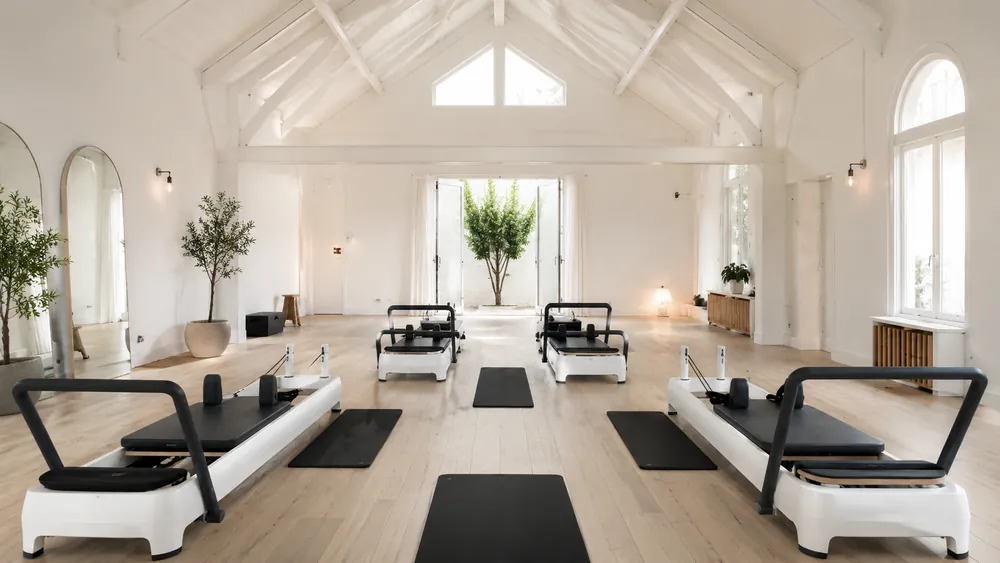
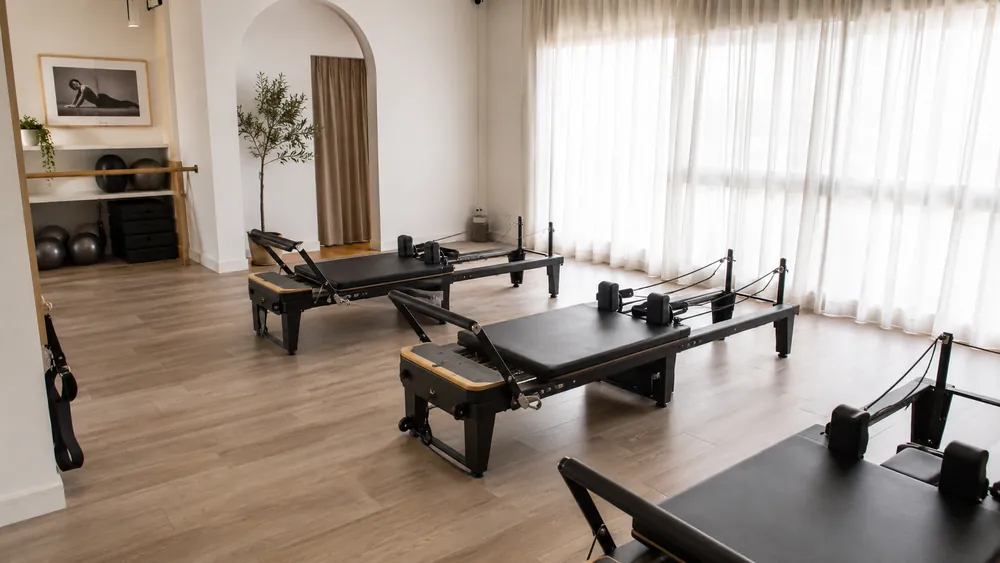
The reformer carriage has a manufacturer weight rating, and it varies a lot by manufacturer, model, and age of the equipment. The rating also usually covers the dynamic load (you pushing against the springs), so the practical safe limit is lower than any headline number, and older equipment in smaller studios may be rated lower again. The major makers publish specifications, but we found they don't list a clear user weight limit consistently on their public product pages, so don't try to guess yours from a number online. Ask your studio for the specific rating on the reformers you'll actually use, ideally from the manufacturer's documentation. A studio that doesn't know its own equipment's rating is a studio that may have you on a machine outside its intended use.
Class flow tends to assume a fairly narrow range of body shapes. Tucks, deep folds, and certain stretches were designed for a body without significant abdominal volume. A good instructor knows the modification for every move; an inexperienced one will simply leave you out of the move or skip past you in the correction sweeps.
Studio culture varies enormously. Some studios make modifications a normal part of how everyone trains. Others run a culture where modifications quietly mark you as the person who can't keep up. The difference is real, and it shapes whether you come back.
None of this is a reason not to start Pilates. It's a reason to be selective about where.
What "modifications" should mean
A common misframing in fitness culture is that modifications make a move "easier." The Australian Pilates educators who work most thoughtfully with diverse bodies push back on that. A modification changes the move so you can do it correctly for your body, with the same target muscles working in the same way.
A reformer footwork variation isn't easier when the carriage is set lighter; it loads the deep stabilisers differently and lets you build the pattern that the heavier load will eventually need. A modified plank with knees down isn't a failed plank; it's the version that lets you train core engagement without compensating through the shoulders.
A good instructor offers the modification without singling you out. The cue sounds like "if you want this version, take it; if you want the other, take that one," not "Sarah, do the easier one." A great instructor will quietly set your reformer to the modification level before you arrive, so you never have to ask.
When you tour a studio, watch for this in how the instructor talks about modifications, in their marketing, on social media, or in the first conversation. The framing tells you almost everything.
Five questions to ask before booking
Use these in the email or call before you commit to an intro pack.
1. What's the weight rating of the reformers I'd be using? A studio that knows the answer takes its equipment seriously. A good answer is specific and sourced ("our reformers are rated to X kg per the manufacturer's specs, and that includes the dynamic load"). A studio that can't tell you, or has never checked, hasn't thought about it.
2. Do you have instructors who work regularly with plus-size or larger-bodied clients? Some studios have one instructor who's built a reputation here. They often attract a more diverse client base and a more comfortable culture. Ask for a recommendation by name.
3. What modifications do you offer for the foundational reformer exercises? You're listening for fluency. A confident answer might be: "for footwork we offer a wider stance and a lighter spring; for short box we have a stable variation that doesn't need a deep tuck; for inversions we have alternatives that work the same muscles without the position." A vague "we'll modify if you need it" is less reassuring.
4. What's your beginner pathway, and how individualised is it? A studio that runs a one-on-one or one-on-two introductory session before group classes has built more individual attention into the start. That's meaningfully better than being dropped into a packed reformer class with a "we'll keep an eye on you."
5. Can I look at the studio in person before I book my first class? A studio that offers this freely is confident in its space. If the answer is no for vague reasons, that's a small signal worth noting.
What to look for in the studio's marketing
Five visible signals that tell you whether "all bodies welcome" is real.
The photos. Look at the studio's Instagram, website, and Google Business profile. Is there visible body diversity, or is it the same five thin women in the same activewear brand? You can usually tell within two minutes of scrolling.
The instructor bios. Studios that take inclusivity seriously often mention it in profiles ("works with diverse bodies," "trained in adaptive Pilates," "specialises in larger-bodied clients"). Studios that don't will list only generic credentials.
The class descriptions. Look for "all bodies," "modifications offered for every level," "scaling options for every move," "rehab-friendly," "gentle." Words like "shred," "transform," "burn," and "sculpt" lean toward a fitness-aesthetic culture that may or may not be welcoming.
The pricing structure. Studios offering a single one-on-one introductory session at a reasonable price are signalling they want to meet you where you are. Studios that require a full membership before any individual time are signalling the opposite.
The reviews from people who look like you. Read reviews on Google, ClassPass, or community forums. Look for plus-size practitioners describing their experience. Their words will tell you more than any marketing copy.
What to expect in your first class
A few things worth knowing about your first class as a plus-size beginner. Our first reformer class guide covers the general run-through; this is the plus-size layer on top.
The reformer is more accommodating than you might think. The springs adjust to your strength, not your size. The carriage is wide enough for most body shapes, and the straps adjust. A good instructor will set the equipment for you before class starts, so the only job left is to show up and follow cues.
You may surprise yourself with how strong you already are. Pilates uses the deep stabilisers, glutes, and core in ways most other exercise doesn't, and plus-size practitioners often have real base strength in the legs, hips, and core from moving their body weight through everyday life. A good instructor draws that out rather than treating it as something to work around.
The first 4 to 6 classes will be the hardest, and not for the reason you'd expect. The hard part usually isn't the physical work; it's the mental work of being in a new room, with new equipment, around new people. Once that settles (often by class 5 or 6), many plus-size beginners describe Pilates as one of the few fitness contexts where they feel genuinely good about what their body can do. Finding the right studio is a matter of filtering, not of the supply not existing. AUSactive's 2022-23 Annual Report records around 15,000 fitness professionals and roughly 3,500 fitness, yoga, and Pilates businesses across Australia, so there are plenty of studios to choose between.
Studios in Australia worth knowing about
A few categories tend to do this well.
Clinical Pilates and physio-led studios. Because they're set up to work with rehab patients of all body types, the culture tends to be more individualised and modification-fluent. The cost is higher per session, but the personalisation is real.
Smaller boutique studios run by experienced instructors. A studio with one or two senior, comprehensively trained instructors who've taught for 10+ years often has a more nuanced approach to body diversity than a chain or a brand-new studio. That depth usually shows up in how they teach diverse bodies.
Studios that explicitly publish a body-inclusive philosophy. Some Australian studios have built explicit body-inclusive identities. They aren't always easy to find, but a search for "size-inclusive Pilates" plus your city or suburb will surface them.
Studios with a community focus. Studios that emphasise community, member events, and member stories (rather than transformations) tend to have more diverse memberships and more welcoming cultures.
The chain reformer studios are a more variable bet. Some locations are excellent; others lean hard on a specific aesthetic. Try the intro offer with eyes open, and trust how you feel after class three more than the marketing.
When a studio isn't the right fit
If you've tried a studio and any of the following is true after 3 to 4 classes, it's the studio, not you:
- The instructor never sets your equipment for you and never offers a modification.
- You're skipped in the form-correction sweeps that other students get.
- You feel watched in a different way to the rest of the class.
- The cueing is consistently aspirational about body change rather than functional about movement.
- You leave classes feeling worse about yourself than when you arrived.
Try another; our guide to choosing a Pilates studio covers how to build the shortlist. Australia has enough studios that the right fit exists; it just sometimes takes more than one try to find.
If a studio has been actively unkind, leave a clear review (Google, social media), tell the studio directly if you want to, and move on. Other plus-size practitioners reading the review will thank you.
A note on home practice and online options
If walking into a studio isn't right for you yet, online classes can be a useful bridge. There are Australian and international Pilates teachers who build their online offering specifically around body-diverse instruction. Recorded mat classes are usually the easiest entry point; you can practise in your own space, at your own pace, with the instructor's voice cueing through your phone or laptop.
Online practice has limits: no real-time form correction, no community, and slower progression in the first 8 to 12 weeks compared to in-studio. But it can build confidence before you commit to a studio, particularly if you're still deciding whether this is for you.
Plus-Size Pilates: Finding a Studio That Welcomes You: common questions
- What weight is the upper limit for using a reformer safely?
It depends entirely on the specific equipment. Ratings vary by manufacturer, model, and age of the machine, and the dynamic-load rating (with you pushing against the springs) is usually lower than the static one (just lying on the carriage). There's no single number that covers all reformers, so ask the studio for the manufacturer's rating on the reformers you'll use, especially if you're unsure where you sit relative to it. Some studios carry heavier-duty equipment for plus-size or athletic clients.
- Will I look weird doing modified versions of moves?
You'll look like a person doing the version that works for your body. So will half the room, who are also modifying for their own reasons (injury, pregnancy, beginner status, a late night). Modifications are normal in any well-run Pilates class.
- I've had bad experiences with fitness instructors before. How do I know this will be different?
You don't, until you try. The signals in the studio's marketing, the instructor's first conversation, and how the first class runs will tell you within 2 to 3 sessions. If those signals are good, the experience usually follows. If they're not, leave and try another. You're not obligated to give a studio more than three classes to prove itself.
- Should I tell the studio my body size before I book?
Optional but useful. Mentioning it ("I'm a size 22, I want to check your equipment and culture work for me before I book") gives the studio the chance to either welcome you specifically or to be honest about whether they're set up for it. The response you get is itself information.
- What about heated yoga or barre? Same principles?
Largely yes. The same questions about equipment, modifications, instructor experience, and culture apply across formats. Heated yoga in particular has extra considerations (heat tolerance, hydration) that warrant a brief check-in with your GP if you have any cardiovascular conditions, regardless of body size.
- Can Pilates help with weight loss?
Indirectly. Pilates builds strength and can support a more active routine, but weight loss is primarily a dietary outcome, and the calorie figures quoted for Pilates online vary too much to be useful, so we won't put a number on it. The honest framing: Pilates is excellent for strength, posture, mood, and the kind of body confidence that comes from feeling capable. If weight loss is the goal, Pilates supports it but isn't the main lever, and a GP or accredited dietitian can help with that side.
Ready to find a studio?
Compare pilates studios across Australia. Filter by location, read real reviews, and enquire direct.