Key points
- Instructor credentials matter more than studio aesthetics: look for PAA-registered or comprehensively trained teachers, not just "certified" with no detail.
- A clean intro offer (2 weeks unlimited, no auto-renew) is the right starting point: use it to test real peak-time availability before signing anything.
- Ask for the cancellation terms in writing before you commit: a reasonable studio offers 30-day notice, no exit fee, and a pause option for injury or travel.
- Class size is a form-correction issue: one instructor covering more than 12 reformers cannot reliably correct your technique, especially as a beginner.
- Pressure tactics during a tour or first class ("this rate is only available today") are a signal about how the business operates, not just how it sells.
The 10 questions at a glance
Ask these before you pay for anything. A studio that passes all ten is worth committing to; one that fails three or more is worth skipping regardless of how good the Instagram looks.
| Question | Good answer | Red flag |
|---|---|---|
| 1. What's your beginner pathway? | A dedicated Foundations or Beginner Series (2 to 3 classes minimum) before you join the standard timetable | "We drop you into the standard class and the instructor will look after you" |
| 2. How big are beginner-friendly classes? | 8 to 12 reformers cap; instructor can actually correct your form in real time | Large room with one instructor on a mic, that's a fitness class, not a Pilates lesson |
| 3. Are instructors PAA-registered or comprehensively trained? | PAA-registered with comprehensive Diploma/Advanced Diploma; bios on website | "All certified" with no specifics, no register listing, no website bios |
| 4. What's really included in the intro offer? | 2-week unlimited on any class, no auto-renew, you actively choose to continue | Intro auto-converts to a paid membership unless you cancel |
| 5. What do class packs cost vs casual? | Specific dollar figures you can do the maths on, published on the website | "Pricing is bespoke" or available only at an intro consultation |
| 6. What's the cancellation policy? | 30 days notice, no exit fee, pause option for injury or travel | 12-month lock-in, exit fees, no pause option, refusing to send terms before you sign |
| 7. What's peak-time availability like? | Specific detail on how far out popular classes book, how the waitlist works | "We're really busy at peak times" with no further detail |
| 8. What equipment does the studio have? | Specific equipment list (reformers, Cadillac, chairs, barrels) with photos | Photos of one row of reformers and vague language about "state-of-the-art" |
| 9. What are the hidden costs? | Transparent list of add-ons (socks, no-show fees, sign-up fee) before you sign | Surprise charges on your card; no-show policy not mentioned until it fires |
| 10. Is the studio AUSactive accredited? | AUSactive accredited or instructors individually registered, can confirm on the directory | Total confusion about what AUSactive is |
Question 1: What's your beginner pathway?
A studio that takes new members seriously runs a dedicated beginner series. It might be called Foundations, Basics, Intro, or Beginner Series, and it's usually 2 to 3 classes (sometimes more) before you join the standard timetable. The teacher walks you through setting spring tension on a reformer safely, getting on and off the carriage, the foundational core cues, and the modifications you'll need until your strength catches up.
Good answer: "We run a 3-class Beginner Series every Tuesday and Saturday, $90 for the series. After that you can join any standard class."
Red flag: "We just drop you into the standard class and the instructor will look after you." That works at small studios with great teachers and small classes. It fails everywhere else, especially at large chain reformer rooms.
Question 2: How big are your beginner-friendly classes?
Class size decides whether the instructor can correct your form. A realistic cap for one instructor doing real corrections is 8 to 12 reformers. Above that, the instructor is cueing from the front and can't physically reach everyone. Some chain reformer studios run far larger rooms with a single instructor and a mic. Those can be perfectly good workouts, but they're not where you want to learn.
A good studio answers this one with a number: "our beginner classes cap at 10 reformers, standard classes run a little higher." If what you get instead is a large room with one instructor on a mic for a beginner class, that's a fitness class, not a Pilates lesson.
Question 3: Are your instructors PAA-registered or comprehensively trained?
This question separates the experienced teachers from the entry-level ones. The Pilates Association Australia maintains the register and sets the scope-of-practice standards. Comprehensive Pilates training in Australia is a nationally accredited Diploma or Advanced Diploma covering the full apparatus (mat, reformer, Cadillac, chair, barrel), which you can confirm against the PAA's recognised education list. A shorter Certificate IV in Pilates (the entry-level qualification taught at fitness colleges, with current courses listed on training.gov.au) is a different qualification. Both can produce good teachers. The gap matters most if you have an injury history or you want to progress well past beginner work.
Good answer: "All our instructors are PAA-registered with comprehensive training. Two are also physiotherapists." Or: "Most of the team is comprehensively certified, and each instructor's bio is on the website."
Red flag: "Our instructors are all certified", with no specifics, no register listing, and no website bios.
Question 4: What's really included in your intro offer?
Intro offers get you in the door, and they're also where studios most commonly mislead. A clean intro offer in Australia is 2-week or 14-day unlimited access for around $45 to $80. The bait-and-switch versions look like a great deal but quietly limit you to off-peak times, exclude the popular instructor's classes, or auto-roll into a paid membership unless you actively cancel.
Good answer: "Two weeks unlimited on any class for $59. No auto-renew. If you want to continue, we'll send you a few options."
Red flag: Intro offers that auto-convert to a paid membership unless you cancel. Always ask: "What happens at the end of the 14 days? Do I have to do anything to stop being charged?" If you have to actively cancel to avoid a charge, that's a marketing-trap decision, not a customer-friendly one.
Question 5: What's the casual class rate, and what do class packs cost?
Use this to back into the real per-class cost across pricing tiers. In Australia, casual reformer drop-ins typically run $35 to $60 depending on location and studio segment. Class packs of 5 or 10 usually save roughly 15 to 25% per class. An unlimited membership (commonly $200 to $350 a month) only beats a 10-class pack if you go three-plus times a week, which most beginners aren't doing for the first few months.
Good answer: Specific dollar figures you can do the maths on, published on the website rather than hidden behind a tour booking.
Red flag: "Pricing is bespoke" or "we'll discuss it at your intro consultation." That's the studio reading your willingness to pay before quoting. Walk away unless you genuinely don't care about cost.
Question 6: What's the cancellation policy on memberships?
This is the question most beginners forget, and the one most likely to bite later. A reasonable policy: 30 days written notice, no exit fee, the option to pause for genuine reasons (injury, travel, pregnancy). An unreasonable one: a 12-month lock-in contract, exit fees, no pause option, monthly direct debit even if you miss every class.
Specifically ask:
- What's the notice period to cancel?
- Can I pause for travel or injury, and for how long?
- Is there an exit fee or minimum term?
- What happens if my circumstances change (pregnancy, job loss, relocation)?
Good answer: "30 days notice, no exit fee, and you can pause for up to 12 weeks a year for any reason." Some studios are more generous, some stricter. The exact terms matter less than getting them in writing before you sign.
Red flag: Refusing to send you the membership terms before you commit. Anyone who won't give you the policy in writing has a reason.
Question 7: What's peak-time availability like?
A membership you can't use when you actually want to train is a waste. The honest version of this question: "If I want the 6:30pm Tuesday class, can I book it three days out?"
The answer depends on the booking system, class size, and how oversubscribed peak times are. Most boutique studios book out 24 to 48 hours ahead for popular classes. Some have waitlists that work well; others have them in name only.
Good answer: "Our 6pm and 7am classes book out 48 hours ahead. The waitlist auto-confirms cancellations 2 hours before class. Most members get into the large majority of classes they want."
Red flag: "We're really busy at peak times" with no further detail. Press for specifics. If they can't tell you, they don't track it, which means you'll pay for the membership and learn the truth later.
Question 8: What equipment does the studio have?
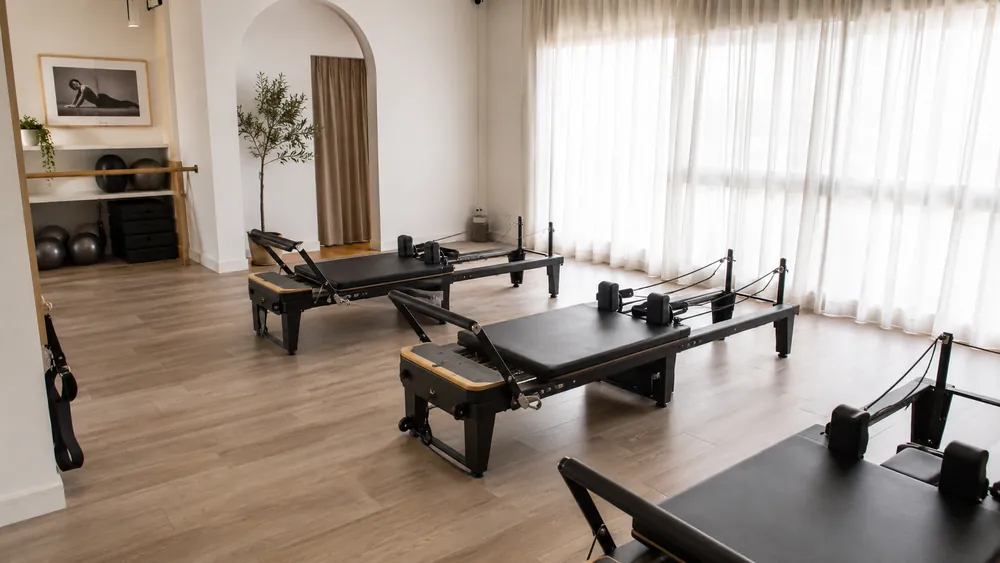
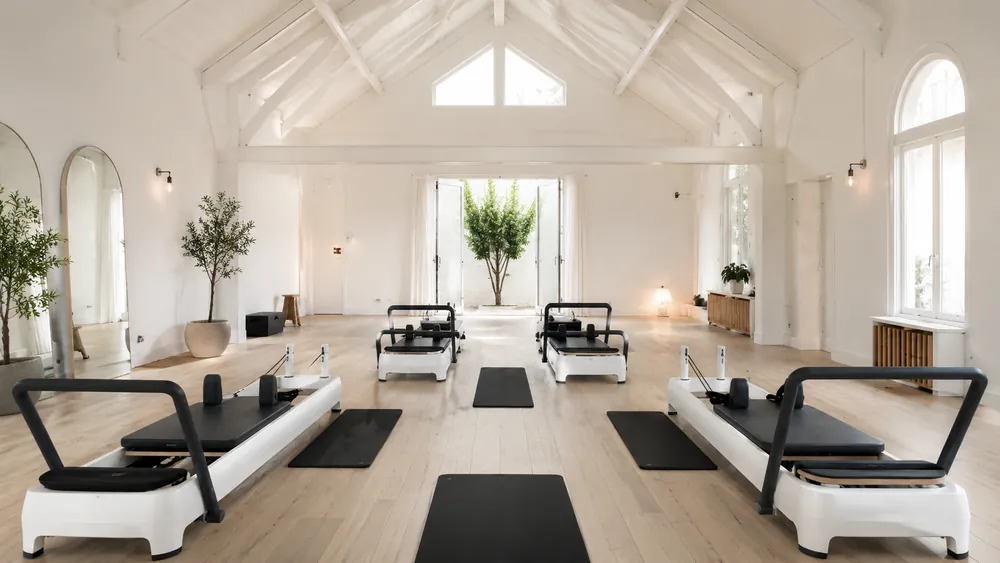
Most studios calling themselves Pilates studios are reformer-focused. Some are reformer-only. Some run full studios with reformers, Cadillacs, towers, Wunda chairs, ladder barrels, and arc barrels. Full-equipment studios run a wider range of work and tend to attract classically trained instructors. Reformer-only studios are typically newer, more group-class-focused, and run a higher class density.
It's about matching what they offer to what you want. If you're after a fitness-style group class, reformer-only is fine. If you're after rehab, technique work, or progression beyond the standard reformer repertoire, a full-equipment studio gives you more room to grow.
Good answer: A specific equipment list, ideally with photos on the website. Studios with full equipment usually advertise it.
Red flag: Photos of one row of reformers and nothing else, with vague language about a "state-of-the-art studio." That's a single-format reformer chain.
Question 9: What are the hidden costs?
Studios sometimes price in pieces that add up. Ask explicitly:
- Do I need to bring grippy socks, or do you sell them?
- Is there a sign-up fee on memberships?
- Are workshops, special events, or guest-instructor classes extra?
- Do you charge a no-show fee, and what triggers it?
The grippy-socks question is small but telling. Most studios require them and most don't include them; they're usually around $15 to $25 a pair at the front desk. The no-show fee matters more: many studios charge a fee if you don't cancel a booking several hours in advance, which is reasonable but catches beginners who don't know it exists.
Good answer: A transparent list of add-ons before you sign, and a no-show policy mentioned at induction.
Red flag: Surprise charges showing up on your card. The fix is asking the question before you sign.
Question 10: Is the studio AUSactive accredited or registered?
AUSactive is the peak body for Australia's exercise and active-health sector. Its Quality Business Accreditation program assesses businesses against a national quality framework through an independent audit, and AUSactive describes it as a three-year continuous-improvement cycle. Not every good studio is accredited, and plenty of strong boutiques aren't (the program leans toward larger facilities). The absence of accreditation doesn't mean a studio is bad. Its presence is a real signal that the studio takes the operational side of the business seriously. You can also check whether a studio or its instructors appear on the AUSactive professional and business directory.
Here the good answer is either "yes, we're accredited" or "no, but our instructors are individually registered with AUSactive." Total confusion about what AUSactive is doesn't disqualify a studio on its own, but an owner who can speak confidently about industry registration is a slightly stronger signal.
A bonus question worth asking: what's your culture like?
This is the soft question most beginners care about most and ask least. Some studios cultivate a friendly, social, talk-to-the-person-on-the-next-reformer culture. Others run quieter: get in, train, get out. Neither is better, but the wrong one for your personality will quietly drain your motivation.
The honest way to find out: take the intro offer, go to three different class times across the two weeks, and notice whether you want to come back. If yes, the culture fits. If you spend the second week dreading the next class, it doesn't, and no amount of good instruction will fix that.
When to walk away from a studio
Three patterns that should make you reconsider.
The studio won't let you try a single class before committing. Some run mandatory Foundations packages with no way to do a single drop-in first. That makes some sense for safety, but it's a high-friction first step. A good studio offers a free or low-cost trial class, or a 2-week intro.
Pressure tactics during the tour or first class. "This rate is only available today", "we have one membership spot left", "sign up now and we'll waive the joining fee." Those are sales scripts, not honest pricing. Good studios don't use them.
The instructor doesn't ask about injuries before your first class. That's a basic safety check. If they skip it, you're learning what their attention to detail looks like.
A studio that passes all 10 questions and the bonus is worth committing to. One that fails three or more isn't, however polished the feed looks.
If you want to know what the classes themselves should feel like before you start asking questions, the reformer Pilates guide and the first reformer class guide cover that side. Ready to build a shortlist? Search for a Pilates studio near you on Studio Finder.
Pressure tactics are a signal about the business
Lines like "this rate is only available today", "we have one membership spot left", or "sign up now and we'll waive the joining fee" are sales scripts, not honest pricing. Good studios don't use them. A studio that fails three or more of the ten questions isn't worth committing to, however polished the feed looks.
Good signs
- A dedicated Foundations or Beginner Series before you join the standard timetable.
- Beginner classes capped at 8 to 12 reformers so the instructor can correct your form.
- PAA-registered or comprehensively trained instructors with bios on the website.
- A clean 2-week unlimited intro with no auto-renew.
- Cancellation terms in writing: 30-day notice, no exit fee, a pause option for injury or travel.
- A free or low-cost trial class before any membership commitment.
Red flags
- The studio won't let you try a single class before committing.
- Pressure tactics such as "this rate is only available today" or "one membership spot left".
- The instructor doesn't ask about injuries before your first class.
- Vague credentials: "all certified" with no register listing and no website bios.
- "Pricing is bespoke" or quoted only at an intro consultation.
- A 12-month lock-in, exit fees, or refusing to send the terms before you sign.
How To Choose a Pilates Studio: common questions
- Should I tour the studio before signing up?
If they offer it, yes. A 15-minute tour lets you see the space, meet the front-desk staff, and ask in person. Many boutique studios don't run formal tours but will happily show you around if you call ahead. Use it to confirm what the website implies.
- What's the difference between a boutique studio and a chain reformer studio?
Boutique studios are usually independently owned, cap classes smaller, and lean on comprehensive instructor training. Chain reformer studios (KX Pilates, VAURA, Bodylove and others) operate at scale, run larger rooms, and standardise their class formats. Both can be good. Pick boutique for detailed technique work or rehab. Pick chain for consistent fitness-style classes near you, if you're okay with less personalised attention. We go deeper in our KX Pilates and cardio Pilates guide.
- What if I sign up and realise the studio isn't right for me?
That's what intro offers are for. Use them. If you've already committed to a membership and realised mid-cycle you've made a mistake, ask about pausing or transferring rather than cancelling outright; many studios will work with you if you're polite about it. The 30-day notice clause exists for a reason.
- Are class packs ever a better deal than a membership?
Often, especially for first-timers. If you're going 1 to 2 times a week, a 10-class pack stretched over a couple of months usually beats an unlimited membership. Memberships only win at three-plus classes a week. The honest test: count how many classes you actually went to last month before committing to unlimited.
- Should I trust the studio's online reviews?
Cautiously. Boutique-scale studios usually have small review counts and a bias toward the very happy or the very upset. Look for patterns, not individual reviews. If most reviews mention great instruction and a friendly culture, that's a real signal. If half mention overcrowded peak times, that's a real signal in the other direction.
Ready to find a studio?
Compare pilates studios across Australia. Filter by location, read real reviews, and enquire direct.