Key points
- Vinyasa links breath to movement: each inhale and exhale drives a transition between poses.
- No two vinyasa classes are the same: the teacher designs a fresh sequence each time.
- Suits beginners who like variety and movement; can range from gentle to very challenging depending on the teacher.
- If you want a fixed sequence you can benchmark against, ashtanga is closer to that.
What vinyasa actually means
The word vinyasa refers to the breath-movement linking method. You don't move and then breathe; the breath directs the move. An inhale takes you into a shape; an exhale transitions you out of it.
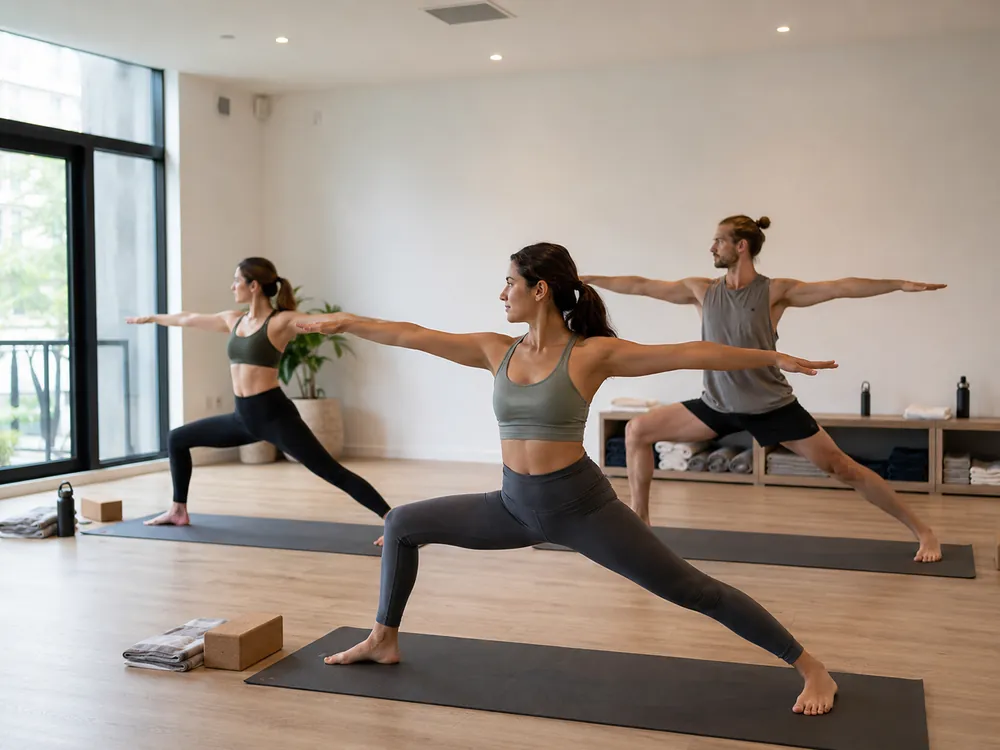
In practice, a vinyasa class is a flowing sequence of standing poses, balance work, floor transitions, and a rest at the end. The instructor designs it, so each class is different. You might work through sun salutations and warriors in one class and something almost unrecognisable the next.
This is the key difference between vinyasa and styles with a fixed sequence. In ashtanga yoga, you do the same poses in the same order every time. In vinyasa, variety is built into the format.
How vinyasa compares to hatha and ashtanga
These three styles are often confused because they share postures. What differs is pace, structure, and approach.
<table> <thead> <tr> <th>Style</th> <th>Pace</th> <th>Sequence</th> <th>Heat generated</th> <th>Best for</th> </tr> </thead> <tbody> <tr> <td>Vinyasa</td> <td>Medium to brisk</td> <td>Teacher-designed, changes each class</td> <td>Moderate to high</td> <td>People who like variety and continuous movement</td> </tr> <tr> <td>Hatha</td> <td>Slow to moderate</td> <td>Varies, often hold-based</td> <td>Low to moderate</td> <td>Beginners, alignment focus, calmer practice</td> </tr> <tr> <td>Ashtanga</td> <td>Brisk and continuous</td> <td>Fixed: same sequence every time</td> <td>High</td> <td>People who want structure and measurable progression</td> </tr> </tbody> </table>A vinyasa class labelled "level 1" will feel very different from one labelled "level 2/3". Check the description before you book if intensity matters to you. The hatha yoga guide goes deeper on the slower option, and the which yoga style guide compares the whole field if you're still deciding.
What a class feels like
The rhythm is the most distinctive thing. Once the class gets moving, there's a continuous tide of inhales and exhales matching each transition. For beginners especially, the pace is the hard part: keeping up with the breath count while also learning the shapes.
A standard vinyasa class runs 60 to 75 minutes and usually includes a warm-up, a building peak sequence, and a wind-down to a final rest pose (savasana). You'll be on your feet more than in a hatha class and sweating more too.
The biggest first-timer mistake is trying to match the experienced people in the room exactly. Take modifications. Rest in child's pose when you need to. A good teacher expects this and will say so.
What it costs and how to start
Vinyasa is one of the most widely available yoga styles in Australia, and pricing follows the general yoga market. Casual drop-ins run around $20 to $35 per class. Two-week unlimited intro offers are commonly $45 to $80, which is the standard way to test a studio before committing to a membership.
A 5 or 10 class pack usually trims the per-class rate by 15 to 25% against casual pricing, and unlimited yoga memberships generally run around $180 to $280 a month.
These are 2026 ranges that vary by studio and city. Check the studio's own pricing before you book. Ready to find a class? Search for a vinyasa studio near you on Studio Finder.
Vinyasa Yoga: common questions
- Is vinyasa yoga good for beginners?
Yes, with the right class. Look for one labelled "beginner", "level 1", or "foundations". The flow can be intense in a level 2 or 3 class, but a good beginner class introduces the key transitions gradually. Tell the teacher it's your first vinyasa class.
- How many calories does vinyasa yoga burn?
Calorie burn in yoga depends on your body weight, fitness level, class intensity, and how much of the session you're actively moving. Vinyasa is more physically demanding than slow-hold styles, so your heart rate will be higher, but specific figures vary too widely between people and classes to quote reliably. Treat vinyasa as a worthwhile physical practice that builds strength, flexibility, and cardiovascular fitness, not as a calorie-counting tool.
- What is the difference between vinyasa and power yoga?
Power yoga grew out of vinyasa and ashtanga in the 1990s. It keeps the flowing, breath-led movement of vinyasa but emphasises strength, athleticism, and intensity more deliberately. Many studios use the terms loosely or interchangeably. If the description uses words like "strong", "athletic", or "level 2", that's more of a power class, whatever the timetable calls it. The power yoga guide covers it in full.
- Do I need to be flexible to do vinyasa yoga?
No. Flexibility is something you build through practice, not a requirement to start. Blocks, straps, and modifications are available in every good class, and instructors adjust poses for different bodies. Start where you are.
Ready to find a studio?
Compare yoga studios across Australia. Filter by location, read real reviews, and enquire direct.