Key points
- Mat Pilates at home can cost nothing beyond a mat, a legitimate way to start and maintain.
- A studio adds the two things home practice can't easily replicate: live form correction and the reformer.
- Without an instructor watching, form drift goes unnoticed: small misalignments can compound over weeks.
- If you have an injury, pregnancy, or a health condition, see a physio before choosing home or studio.
Can you do Pilates at home? Yes, and here's what that looks like
Mat Pilates is the version built for home practice. It needs a mat, a clear patch of floor, and optionally light kit like a resistance band or a small ball. There's a deep library of free and paid class videos, and the entry cost is close to nothing.
What you're doing on the mat is the foundation of the whole method: controlled, precise movements coordinated with breath, with the work originating from your core. Those fundamentals of breath, control, precision and centring (initiating movement from your core) carry through every style of Pilates, so a home mat practice is the real thing, not a lesser version. What's harder at home is knowing whether you're doing it right.
For a fuller look at the at-home format itself, the mat Pilates guide goes deeper on what to expect and how to progress.
What a studio actually adds
Real-time correction from an instructor, and equipment like the reformer: those are the two things home practice can't easily replicate. Both change the quality and the safety of what you're doing.
The first is the instructor watching your body. On a video, the teacher can't see that your shoulders are creeping up or your lower back is arching off the mat. In a class, a qualified instructor can watch and adjust your form as you move. Australia's national health service, healthdirect, notes that instructors can adjust Pilates moves to suit all ages and fitness levels, and the medical literature notes that the injury risk in Pilates may be lower when you're in a class with someone who can correct you (Medical News Today). For a beginner, that feedback loop is the difference between grooving in good habits and grooving in bad ones you'll have to unlearn later.
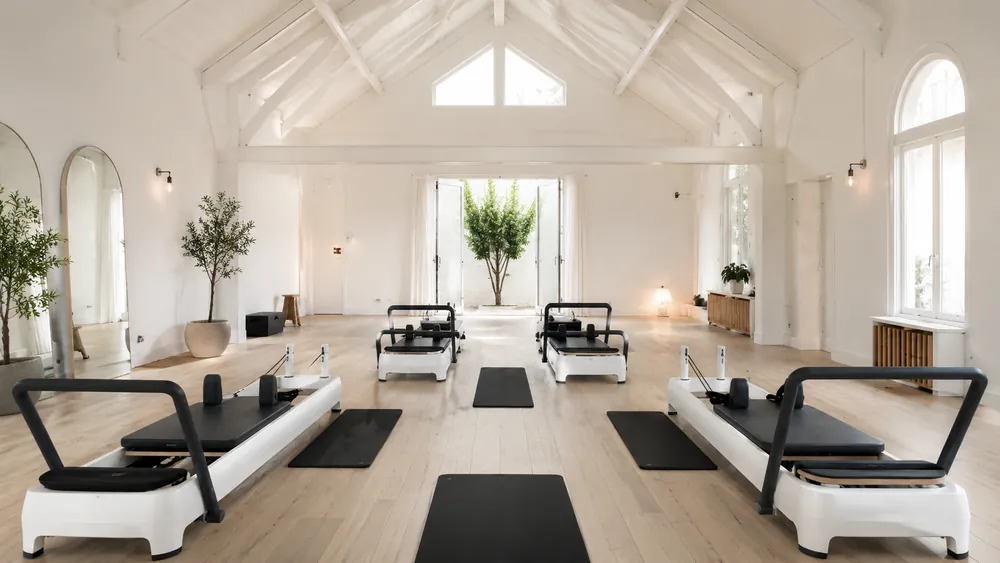
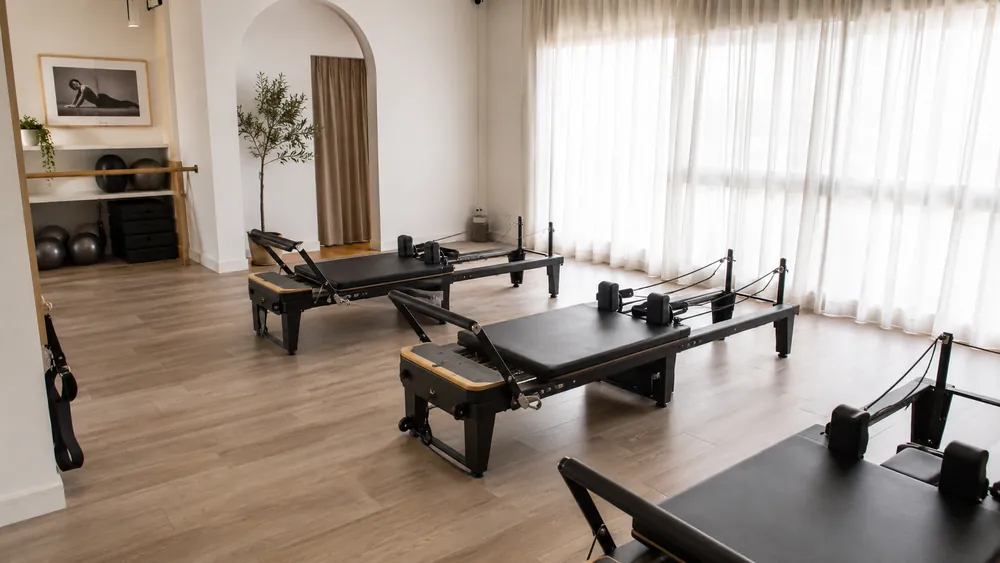
The second is the reformer. A reformer is a sliding carriage on springs that loads your movements with adjustable resistance, and reformer Pilates mostly happens in a studio for the simple reason that studios are where the machines are. It opens up exercises and a kind of resistance you simply can't get on a mat. You can buy a reformer for home use, but they're a significant cost and you lose the instructor, so for most people the reformer is a reason to go to a studio rather than recreate one at home. The reformer Pilates guide covers what a first class is like.
What you give up by staying home
Correction, accountability, and equipment: that's what you trade away by staying home, in exchange for convenience and cost.
The big one is form. Without anyone watching, a beginner can drill a movement slightly wrong for weeks. It might not hurt, but it blunts the benefit, and at worst it loads a joint in a way that isn't doing you favours. It's why healthdirect advises beginners to start slowly and focus on learning the right way to do each move, and notes that beginners or anyone with an injury may be better off starting with a one-on-one session so an instructor can assess them properly.
The quieter one is showing up. A booked class at a set time, in a room with other people and an instructor expecting you, is a stronger commitment device than "I'll do a video later". Plenty of home practices fade out not because the workouts were bad but because nothing held the person to them.
And you give up the reformer and the rest of the studio equipment, along with the variety and progression they allow.
The cost trade-off
Home is cheaper, sometimes free; a studio costs more but buys you the instructor and the equipment.
Mat Pilates at home can cost nothing beyond a mat. Studio classes carry a real price because you're paying for a space, a machine, and a trained person watching you. In Australia in 2026, that gap looks roughly like this: a casual mat Pilates or yoga drop-in in the $20 to $35 bracket against $35 to $60 for a casual reformer session, with the exact figure set by the studio and the city. If you want to test a studio properly, the two-week unlimited intro offer most studios sell (expect somewhere between $45 and $80) is the honest way in, and once you're a semi-regular a class pack trims roughly 15 to 25% off the casual rate. Unlimited reformer memberships sit at the top of the ladder, usually $200 to $350 a month, and only make sense if you're going several times a week. The full cost comparison, including how gym pricing stacks up, lives in the Pilates vs gym guide.
A reasonable middle path for a lot of people is to learn the fundamentals at home or in a few studio classes, then use the studio for the reformer and the periodic form check.
So who does each one suit?
Match the setup to what you want and where your body's at.
Home (mat) suits you if: you're curious and want to try Pilates without spending much, you value training on your own schedule, you travel a lot, or you already know the basics and just want to keep ticking over between studio sessions.
A studio suits you if: you're a beginner who wants your form watched from day one, you want to try the reformer, you find you actually show up when a class is booked, or you want the variety and progression that equipment and a programmed class give you. If you can stretch to it, even a short block of studio classes early on pays off in better habits.
If you've got an injury or a health condition, see a professional first
This is the one place the home-versus-studio question stops being about preference. If you're recovering from an injury, managing a health condition, or pregnant, get personalised advice before you start. The medical guidance is consistent: people with a health condition that affects mobility or bone strength should speak with their healthcare team first, and people who are pregnant should speak with their doctor before starting reformer Pilates or any new exercise (Medical News Today).
In practice that usually points toward a studio rather than a solo home video, and often toward a studio with physiotherapist-led or rehab-focused classes, because someone qualified can adjust the work to your situation. A physio or your GP is the right person to tell you what's safe for your body. A video can't, and neither can this page. This is general information, not personal medical advice.
When you're ready to compare studios, you can browse Pilates studios by location on Studio Finder, or search by suburb and style to find a beginner-friendly or rehab-focused class near you.
Can You Do Pilates at Home vs Studio: common questions
- Can beginners do Pilates at home?
Yes. Mat Pilates is a reasonable place for a beginner to start at home with a mat and a class video, since mat work needs no equipment. The trade-off is that nobody's checking your form, so a few studio classes early on, or an occasional form check, helps you build good habits before they set.
- Do I need a reformer to do Pilates?
No. The reformer is one piece of Pilates equipment, not a requirement. Mat Pilates uses your body weight and a mat. The reformer adds spring resistance and exercises you can't do on a mat, and because the machine and an instructor live in a studio, reformer Pilates is mostly a studio activity.
- Is it safe to do Pilates at home without an instructor?
For most healthy beginners doing gentle mat work, it's a common way to start, but the catch is form. Injury risk in Pilates may be lower when a qualified instructor can watch and correct you (Medical News Today). If you have an injury, a health condition, or you're pregnant, speak with a physiotherapist or your doctor before starting. This is general information, not personal advice.
- Is home Pilates as good as a studio?
It depends what you're after. For learning the basics, staying consistent on a budget, and general movement, a home mat practice can do a lot. For hands-on correction, the reformer, and structured progression, a studio adds things a video can't. Many people use both: home for frequency, studio for the reformer and the occasional form check.
- How much does a Pilates studio class cost in Australia?
It varies by studio and city, so treat these as rough 2026 ballparks rather than quotes. Casual mat Pilates drop-ins tend to sit around $20 to $35, casual reformer classes more often around $35 to $60, and a 2-week unlimited intro offer commonly somewhere around $45 to $80. Check the studio directly for its current pricing.
Ready to find a studio?
Compare pilates studios across Australia. Filter by location, read real reviews, and enquire direct.