Key points
- Restorative yoga props you up so completely that your muscles can fully let go: the goal is rest, not effort.
- A whole class might cover only 4 to 6 poses held for several minutes each, sometimes up to 20 minutes.
- Popularised by Judith Lasater, a student of B.K.S. Iyengar: it has a clear modern lineage, not an ancient one.
- It is recovery and nervous-system downshift, not exercise. Pair it with active styles, not replace them.
What is restorative yoga?
Restorative yoga is a slow, deeply supported style where you hold a small number of gentle poses for several minutes each, propped up so your muscles can fully relax. Each pose is held far longer than in a conventional class, sometimes for as long as twenty minutes, so a whole session might consist of only four to six poses, a format the Wikipedia overview of restorative yoga documents. The long holds are assisted with props such as folded blankets, blocks, and bolsters to ensure the body is fully supported and so the muscles can release.
The point is rest, not effort. The goal is relaxing the body and reducing stress. You are not working toward anything physical. You are removing the work entirely and letting the support do it for you.
The style grew out of the prop-based teaching of B.K.S. Iyengar, whose deliberate use of props in asana practice foreshadowed it, and it was popularised by his student Judith Lasater, the yoga teacher and Yoga Journal editor. So it has a clear modern lineage rather than an ancient one, which is worth knowing if a studio markets it otherwise.
How restorative compares to yin and other styles
The comparison people get wrong constantly is restorative versus yin, so start there.
Restorative vs yin. They look almost identical from the doorway. Both are slow, quiet, floor-based, prop-assisted, and hold poses for several minutes. The difference is what you are meant to feel. Restorative props you up so completely that you feel almost nothing and can fully rest. Yin deliberately leaves you in a real, sometimes intense, stretch-like sensation in the connective tissue. The Wikipedia entry draws the same practical line: yin uses props in a similar way and holds poses for similarly long periods, but is aimed mainly at healthy practitioners and taught in larger classes, while restorative is geared toward people dealing with injury, stress, or illness, in smaller classes with closer attention. Put simply: restorative is comfort, yin is comfortable discomfort.
Restorative vs hatha. A hatha class holds poses too, but with the muscles engaged and often standing, working alignment and a bit of strength. Restorative removes the muscular work altogether and keeps you supported on the floor. Hatha is a gentle practice; restorative is barely a practice at all in the effort sense, by design.
Restorative vs the active styles. Against vinyasa, power yoga, or hot yoga, there is no contest on intensity. Those build heat, strength, and a sweat. Restorative does none of that and is not trying to. It is the recovery side of a movement week, the counterweight to the hard sessions, not a substitute for them.
If you are weighing up the slow styles against each other, the which yoga style guide lays them out side by side.
| Style | Sensation in poses | Movement | Props | Best for |
|---|---|---|---|---|
| Restorative | Close to nothing: full support | Minimal | Extensive (bolsters, blankets, blocks) | Stress, illness recovery, genuine rest |
| Yin | Real, sometimes intense stretch | Minimal | Some (mainly for support) | Connective tissue, flexibility, healthy practitioners |
| Hatha | Muscular effort and mild stretch | Slow to moderate | Some (blocks, straps) | Alignment, beginner-friendly, calmer practice |
| Vinyasa / power | Muscular work, cardiovascular effort | Continuous flow | Minimal | Fitness, strength, active practitioners |
What a restorative class actually feels like
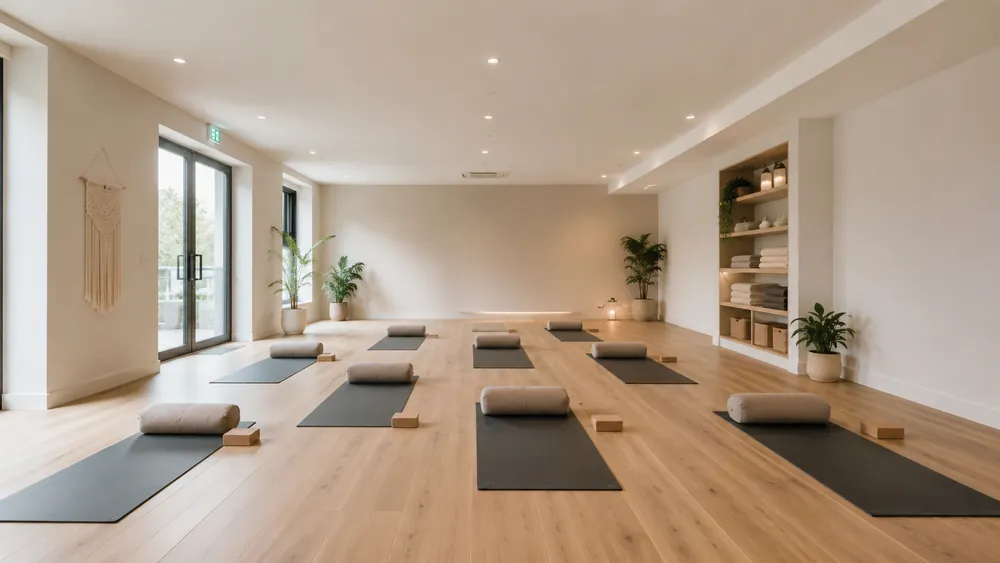
Expect a warm, dimly lit, quiet room with a pile of props at every spot: bolsters, several folded blankets, blocks, sometimes an eye pillow and a strap. The first surprise for most people is how long the setup takes. A teacher will spend real time arranging the props so that when you settle in, every part of you is held and nothing has to hold itself.
Then you stay. Poses are mostly reclining or seated and supported: a bolster under the spine, legs draped over a prop, a blanket roll behind the knees. You might do a supported reclining pose, legs up the wall, a gentle supported twist, and a long final rest, and that could be the whole class. The repertoire is deliberately small: a handful of supported poses and their variants, each held at length, and a teacher will often return to the same shapes week after week.
The physical sensation is close to nothing, and that catches people out. There is no stretch to chase and no burn to push into. The work, if you can call it that, is mental. Lying still and supported for twenty minutes sounds easy and is not, because the body relaxes long before the mind agrees to.
Many classes pair the holds with slow breathing or a guided wind-down. The overall feel is closer to a long, supported meditation than to exercise.
Who restorative yoga suits
Restorative is built for a particular need: mainly people dealing with injury, stress, or illness who need a practice that brings them back toward a better quality of life, which is why classes are kept small and the attention is close. So if you are run down, recovering, or chronically stretched thin, this is the style designed around you.
It also suits anyone whose week is already full of hard movement and who needs genuine recovery rather than another session of effort. If you run, lift, do power yoga or reformer Pilates, restorative is the counterweight that lets the body actually repair. healthdirect notes that yoga's mindfulness and breathing elements may help you feel calmer, more relaxed and focused, per its overview of yoga and Pilates, and restorative leans into that side harder than any other style.
It suits people who find faster yoga stressful rather than energising, and people who want to wind down in the evening. You do not need any flexibility or fitness to start, because the props meet your body where it is.
Who it suits less: anyone after a workout, a sweat, or visible physical progress. Restorative does almost no muscular or cardiovascular work and is not meant to. If that is your goal, an active style fits better, and you can pair restorative with it rather than replacing it.
What to expect your first time
First-timers settle in faster with a bit of preparation.
Let the props do everything. The instinct from other yoga is to hold yourself in a shape. Here, the entire skill is letting go and trusting the bolster. If anything is taking effort to maintain, ask the teacher for another prop. There is always another blanket.
Dress warm and bring socks. You generate almost no heat lying still, so rooms are kept warm but you can still cool down over a twenty-minute hold. A jumper and warm socks make a real difference to whether you actually relax.
Do not worry about a busy mind. Most beginners are surprised that staying still is mentally harder than a sweaty flow, and assume they are doing it wrong. They are not. The restlessness settling over a long hold is the practice working.
If walking into a quiet studio for the first time is the part you are dreading, the first yoga class guide covers the practical side of turning up.
Cost and intro offers in Australia
On price, restorative sits with the other unheated styles rather than commanding a premium: expect a casual class somewhere around $20 to $35 in 2026, varying by studio and city. There is no equipment surcharge here, since the bolsters and blankets come with the room.
The way most people buy it is different from the active styles, though. Restorative is usually one class in a broader week rather than the whole practice, so a class pack you can spread across restorative and an active style tends to make more sense than a dedicated membership. If a studio's intro offer includes restorative classes, that is an easy low-cost way to find out whether lying still for an hour is your kind of rest. The yoga cost guide covers casual rates, packs, memberships and intro offers in full. To see who runs restorative classes near you, browse Studio Finder's yoga listings or search by suburb.
A few things worth flagging to your teacher
Restorative is gentle, but a quiet word before class still helps in a few situations, partly because the style is so often chosen by people who are recovering from something.
- Any injury, recent surgery, or condition you are managing. Restorative is frequently chosen precisely for recovery, and a good teacher will prop and position you around it, but they need to know first.
- Pregnancy. healthdirect notes yoga is generally safe in pregnancy but that some positions may need changing, per its yoga and Pilates overview. Several reclining poses are easy to adapt with extra props.
- Anything that makes lying on the floor or staying still for long periods uncomfortable, so the teacher can offer a chair-supported or seated alternative.
healthdirect notes that yoga's mindfulness and breathing may help you feel calmer and more relaxed, and that relaxation techniques can form part of treatment for some mental health conditions, though it points you to your doctor for those. That doctor-first advice applies double for restorative, given how often the style is chosen by people recovering from something. If you want to check a teacher's credentials, Yoga Australia keeps the national register.
Restorative Yoga: common questions
- What is the difference between restorative yoga and yin yoga?
Both are slow, quiet, and prop-assisted with long holds, so they look alike. The difference is sensation. Restorative props you up so you feel almost nothing and can fully rest, while yin keeps you in a real, sometimes intense stretch sensation in the connective tissue. Restorative is aimed more at people dealing with stress, injury or illness, in smaller classes; yin mainly at healthy practitioners in larger ones.
- Is restorative yoga actually a workout?
No, and it is not meant to be. It does almost no muscular or cardiovascular work by design. The benefit is rest and nervous-system downshift, not exercise. For strength or fitness, pair it with an active style like vinyasa or power yoga and treat restorative as the recovery side of your week.
- Do I need to be flexible or fit to do restorative yoga?
No. The props meet your body where it is, so flexibility and fitness are not prerequisites. It is one of the most accessible classes on a timetable, which is part of why it suits people recovering from injury or illness.
- Is restorative yoga good for stress and sleep?
Many people use it to wind down, and the slow, supported, near-meditative format suits that. healthdirect notes yoga's mindfulness and breathing elements may help you feel calmer and more relaxed, per its yoga and Pilates overview. If you have a diagnosed sleep or anxiety problem, raise it with your GP rather than treating a class as a fix.
- How long are poses held in restorative yoga?
Several minutes each, sometimes up to twenty, which is why a whole class might only cover four to six poses. The long, fully supported hold is what lets the body settle into deep rest.
Ready to find a studio?
Compare yoga studios across Australia. Filter by location, read real reviews, and enquire direct.