Key points
- Hatha is a general term for physical yoga: in Australia, it usually refers to a slower, hold-based class.
- Poses are typically held for 30 seconds to a few breaths, with alignment cues throughout.
- Most modern yoga styles (vinyasa, ashtanga, hot yoga) descended from or grew alongside hatha.
- The best starting point for beginners who want clear instruction and a gentler pace before trying flowing styles.
What is hatha yoga?
Hatha yoga is the branch of yoga built on physical postures and breathing techniques, and in the modern world it has become the base most studio yoga grows from. Encyclopaedia Britannica's entry on hatha yoga describes it as the school of yoga that works through mastery of the body, and glosses the Sanskrit name as a discipline of force. In the 20th century, a version of hatha focused on the physical postures spread worldwide as exercise, and that modern form is what most people now simply call yoga.
That is the source of the confusion. By the textbook definition, your vinyasa class, your power class, even your hot class are all forms of hatha yoga. They are posture-based practices descended from the same root. So when a studio runs a class simply labelled "Hatha," it is using the narrower, everyday meaning: a slower-paced class, posture by posture, with longer instruction and no continuous flow.
What you will not get in a typical hatha class is the spiritual heavy lifting some people expect from the name. The historical texts go deep into breath, energy, and meditation, but a modern studio hatha class is mostly physical postures plus some breath work, taught for general fitness and calm.
How hatha compares to other yoga styles
Hatha vs vinyasa. This is the comparison that matters most for beginners. A vinyasa class links each movement to a breath and keeps you flowing, often through forty to eighty postures, at a moderate to brisk pace. Hatha stops at each pose, holds it for several breaths, and the teacher talks you through the alignment. Vinyasa is choreography; hatha is the rehearsal where you learn each step.
Hatha vs yin. Both are slow, but they work differently. A yin class holds floor poses for three to five minutes with the muscles switched off, loading the connective tissue. Hatha holds for a handful of breaths with the muscles engaged, often standing, building strength and balance as well as flexibility. Hatha works the muscle; yin works the joint.
Hatha vs ashtanga. Ashtanga is a fixed, demanding sequence done at pace, usually self-led once you know it. Not a beginner format. Hatha has no set sequence and moves slowly enough to learn in real time.
Hatha vs hot yoga. A hot yoga class adds a heated room and the intensity that comes with it. Standard hatha runs at room temperature. If the heat is the appeal, hatha will feel mild; if the heat is the worry, hatha is the calmer choice.
What a hatha class actually feels like
Expect a measured pace and a teacher who explains as you go. A typical hatha class opens with a few minutes of settling and breath work, moves through gentle warm-up movements on the mat, then works through standing and seated postures one at a time, and closes with a few minutes lying still in savasana.
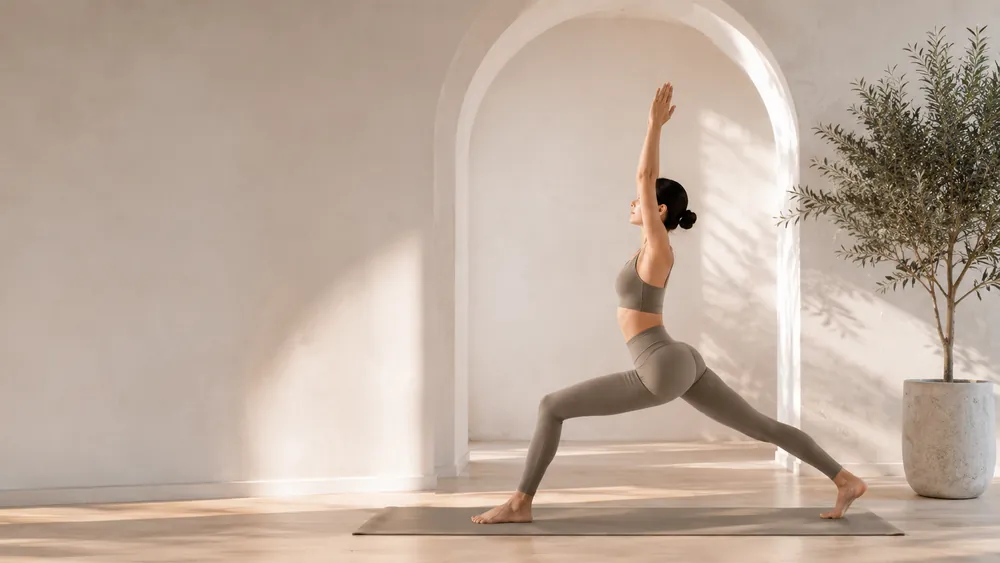
The defining feature is the holds. You move into Warrior II, or Triangle, or a seated forward fold, and you stay there for several breaths while the teacher cues where your weight should sit, what your shoulders are doing, where to soften. That held time is when you feel the work: a static hold in the legs is harder than it looks, and your standing leg, hips, and shoulders will let you know.
A good hatha class earns its slowness. The instruction is detailed, the modifications are offered freely, and you leave understanding the poses better than when you arrived. A weak hatha class is the opposite, and it is worth naming the difference. If the room mostly sits around between vague instructions with no real holds and no alignment cues, that is a poorly run class wearing the hatha label, not the style itself. The held postures and the teaching are the point.
You will likely do some pranayama, the breathing practice, usually at the start or woven between postures. In a studio hatha class this tends to be simple: lengthening the breath, breathing through the nose, matching breath to a movement. Nothing you need to prepare for.
Who hatha yoga suits
Hatha fits a clear group of people. True beginners, first and foremost, because the slow pace and constant instruction are exactly what a new body needs to learn safely. Anyone returning to movement after a long break, an injury, or a pregnancy, since the controlled tempo makes it easier to feel what your body is doing. People who found vinyasa too fast and want to actually learn the postures. And anyone who wants the calm and flexibility of yoga without a heated room or a cardio pace.
It also suits people who want a genuinely sustainable weekly practice rather than a workout to grind through. The general health benefits, including better posture, strength, balance, flexibility, and a calmer mind, are summarised by the Australian government health service healthdirect, which lists hatha among the popular styles of yoga.
Who it suits less: if you want a sweat, a strong cardio hit, or a fast-moving challenge, hatha will feel slow. A flow or hot class is the better match, and the first yoga class guide lays out how the formats differ so you can pick.
What to expect your first time
You do not need to be flexible, and you do not need any background. Hatha is designed to be learned from scratch, which is the whole reason it gets recommended to beginners. Take every modification offered. The less-deep version of a pose is not a lesser pose; it is the right pose for your body today.
Tell the teacher you are new before class starts. In a slow, instruction-heavy format, that one sentence means they will watch your alignment more closely and offer you options. It is the single most useful thing a beginner can do, and the first-class nerves guide covers how to walk in and say it if that part feels daunting.
Expect to work harder than the slow pace suggests. Holding a standing posture for several breaths is real strength work, and beginners are often surprised to feel their legs shaking in what looked like a gentle class. That is normal. Ease off, breathe, and the hold gets easier over a few weeks of regular practice.
Bring fitted activewear (loose tops fall over your face in forward folds), bare feet (yoga is practised barefoot), and a mat if you have one, though most studios lend or rent them. Skip a heavy meal in the couple of hours before class, since forward folds and twists are unpleasant on a full stomach.
Cost and intro offers in Australia
Hatha sits in the standard band for unheated yoga in Australia: casual drop-ins typically cost $20 to $35 as of 2026. Because hatha is where studios put their beginner and foundations classes, it is also where free or discounted first-class offers show up most often, so look for one before paying a casual rate.
The two-week unlimited intro offer (usually $45 to $80) suits hatha particularly well. Learning postures is a repetition game, and a fortnight of unlimited slow classes teaches you more than a month of scattered drop-ins. Prices move with your city and studio, so confirm on the studio's own page before booking.
A note on the spiritual side, and on safety
Hatha has deep roots in Indian tradition, and the historical practice carries far more philosophy than a modern fitness class. A studio hatha class is generally a physical and breathing practice taught for health, and healthdirect describes yoga in exactly those terms: gentle movements, stretching, breathing, mindfulness, and meditation that support physical and mental wellbeing, per its yoga and Pilates overview. If a class leans more contemplative than you want, the timetable label and a quick look at the studio's description usually tell you in advance.
On safety, the slow pace makes hatha one of the gentler entry points, but the usual rules still apply. If you have an acute injury (especially wrists, shoulders, neck, lower back, or knees), are pregnant, or have a health condition that movement might affect, get clearance from your GP or an Australian-registered physiotherapist first, and tell the teacher before class. You can find a registered teacher through Yoga Australia, the peak national body for yoga teacher registration in Australia.
Hatha Yoga: common questions
- Is hatha yoga good for beginners?
Yes, and it is one of the most commonly recommended starting points. The slow pace, the held postures, and the detailed instruction give a new body time to learn each pose properly, which a faster flow class does not. Look for a class labelled hatha, beginners, or foundations.
- What's the difference between hatha and vinyasa?
Hatha moves through postures one at a time and holds each for several breaths, with the teacher explaining alignment. Vinyasa links movement to breath and flows continuously through many postures at a quicker pace. Hatha is where you learn the poses; vinyasa is where you string them together.
- Will hatha yoga make me strong?
It builds strength, though not the way a gym session does. Holding standing and balancing postures for several breaths is real static work for your legs, core, and shoulders. It improves strength, balance, and flexibility together, which healthdirect lists among yoga's benefits in its overview. For a stronger cardio or sweat-based workout, a flow or hot class fits better.
- Is hatha yoga religious?
A typical studio hatha class is a physical and breathing practice taught for fitness and calm, not a religious service. Hatha does have deep roots in Indian tradition and the historical texts carry significant philosophy, but how much contemplative content a class includes varies by studio. The timetable and class description usually signal it in advance.
- Is all yoga technically hatha yoga?
By the textbook definition, yes, mostly. Modern posture-based yoga descends from hatha, the family of physical yoga the wider world now just calls "yoga". On a class timetable, though, "hatha" is used in a narrower sense: a slower, posture-by-posture class, as distinct from vinyasa, power, yin, or hot.
Ready to find a studio?
Compare yoga studios across Australia. Filter by location, read real reviews, and enquire direct.