Key points
- The reformer is the workhorse: one machine that runs beginner rehab and advanced strength work on adjustable springs.
- A Cadillac (trapeze table) adds overhead bars and springs; a tower gives most of that in less floor space.
- The Wunda chair is compact but demanding: less surface means more exposed balance and stability work.
- PAA-registered studios are required to have at least one each of a Cadillac, reformer, Wunda chair, and barrels.
Where did Pilates equipment come from?
The apparatus traces to one man. Joseph Pilates, born in Germany, developed a movement method he called Contrology and published Return to Life Through Contrology in 1945, per Pilates Anytime's history of Joseph Pilates. Much of the early equipment came out of his time interned on the Isle of Man during the First World War, where he began building spring-based apparatus to help rehabilitate fellow internees. He was a prolific inventor, filing more than 26 patent applications across his apparatus designs, according to the same source.
That origin explains the look of the gear. The springs do a particular job: they can either assist a weak movement or resist a strong one, depending on how you set them and which way you push. That single idea (graded spring resistance you can dial up or down) is what lets one machine carry a beginner through gentle range-of-motion work and an advanced practitioner through serious strength work.
Apparatus at a glance
| Piece | What it does | When you'd use it |
|---|---|---|
| Reformer | Sliding carriage on rails with adjustable springs; resistance or assistance depending on direction | Group classes, beginner to advanced, most Australian boutique studios |
| Cadillac (trapeze table) | Fixed bed with tall overhead frame; springs and bars at multiple heights | One-on-one or small-group work; classical and clinical studios |
| Tower | Vertical spring frame, usually wall-mounted or attached to a reformer end | Space-saving alternative to a full Cadillac; covers much of the overhead repertoire |
| Wunda chair | Compact box with spring-loaded pedal; exposes balance and stability | Strength, control, and balance work; advanced end of most programs |
| Ladder barrel | Curved barrel with a rung ladder; spinal extension, side-bending, leg stretches | Classical and full-apparatus studios; often alongside private sessions |
| Spine corrector / arc | Small saddle-shaped barrel; supports the back through extension and core work | Core work over a curve; complement to reformer and mat in full studios |
What is a Pilates reformer?
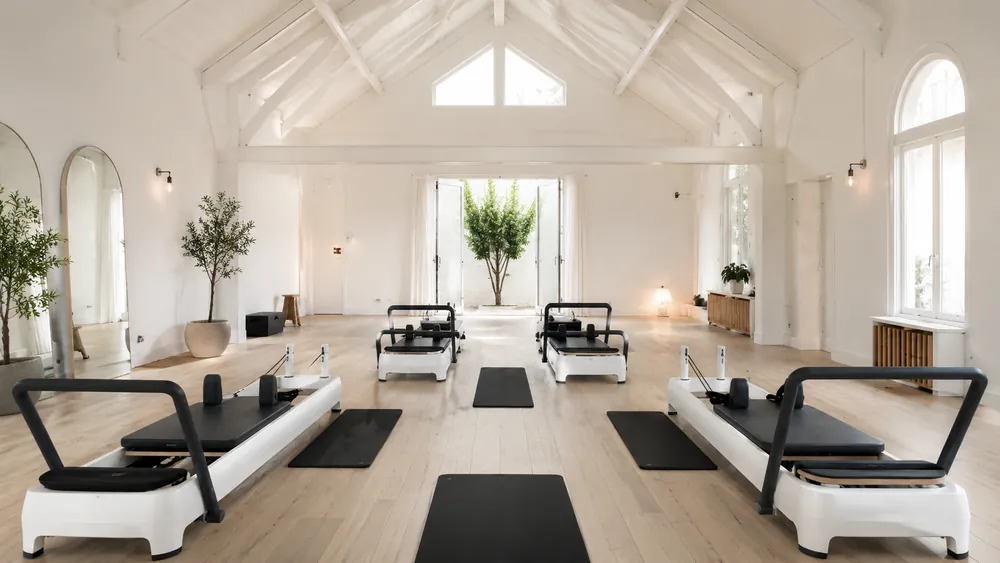
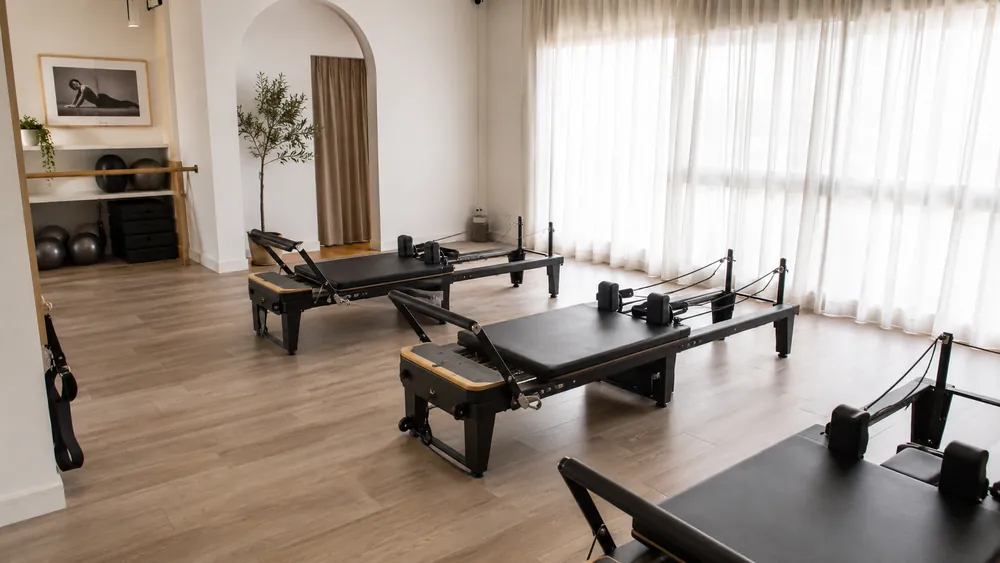
The reformer is a bed-sized carriage that slides back and forth on rails, with springs at one end for resistance and a foot bar, shoulder rests, and straps as anchor points. You work lying, kneeling, sitting, or standing on the carriage, using the springs to load movements you'd otherwise do on a mat. It's the apparatus most Australian boutique studios specialise in, and it's covered in depth in our practical reformer Pilates guide.
What makes it the workhorse is its range. The same machine runs gentle assisted work and demanding strength sequences, because the spring load and your body position change the difficulty continuously. Slow, controlled movement is the norm rather than fast reps. That's why a reformer-only studio can build an entire timetable, from beginner foundations to advanced classes, on one type of equipment.
What is a Cadillac (trapeze table)?
The Cadillac, also called the trapeze table, is a large bed-like apparatus with a tall frame built over it, fitted with springs, bars, straps, and loops at multiple heights. You can work lying on the bed, sitting, kneeling, standing, or even hanging from the overhead bars, which opens up angles and supported positions the reformer can't reach.
The name is a piece of studio folklore. According to accounts attributed to Romana Kryzanowska, one of Joseph Pilates' senior students, a client in the 1940s nicknamed the apparatus the Cadillac after the car, a comparison to its size and comfort (recounted in Pilates Anytime's history of Joseph Pilates). It's the largest and most versatile single piece in a classical studio, which is also why it takes up the most room and tends to be used for one-on-one or small-group work rather than big classes.
Reformer with tower, or full Cadillac?
A tower is, in effect, the Cadillac's frame without the bed. It's a vertical structure, usually wall-mounted or attached to one end of a reformer, that adds spring attachments at different heights above the carriage. Pair a tower with a reformer and you get much of the Cadillac's overhead spring repertoire in a smaller footprint, which is why space-conscious studios often choose a reformer-plus-tower combination over a separate full Cadillac.
The trade-off is room and range. A standalone Cadillac gives you the full bed-and-frame repertoire and suits dedicated apparatus or clinical work. A reformer with a tower attachment saves floor space and equipment spend while covering a large share of the same exercises. Which one a studio installs comes down to its space, its budget, and whether it runs group classes or individual sessions.
What is a Wunda chair?
The Wunda chair is the compact one. It's a small, box-shaped unit with a spring-loaded pedal (or split pedals) at the front, and you work on it seated, standing, lying, or pressing against the pedal from various positions. Despite the size, it's demanding: with less surface to support you than a reformer or Cadillac, it exposes balance and stability work that larger apparatus can let you hide.
Studios like it for two practical reasons. It takes up almost no space, and it adds a different kind of challenge to a program built mostly on the reformer. You'll see it used for strength, control, and balance work, often in the advanced end of a studio's repertoire.
What do the barrels do?
Barrels are the curved apparatus, and there are two common ones. The ladder barrel pairs a rounded barrel with a small ladder of rungs and a gap between them you adjust to your leg length; it's used for spinal extension over the curve, side-bending, and stretching the backs of the legs and the hips. The spine corrector (sometimes called a step barrel or arc) is the smaller, saddle-shaped version that sits on the floor, used to support the back through extension and to work the core over the curve.
Neither has springs. They're shaped surfaces that let you move the spine through ranges that are awkward to support on a flat mat, which is why they round out a classical apparatus set even though they look the simplest. A studio that wants the full traditional repertoire keeps at least one barrel; a reformer-only studio often skips them.
How do studios decide which equipment to run?
The mix follows the model. A boutique reformer studio running group classes is built around a bank of reformers, sometimes with towers attached, and may carry little else. A classical or clinically oriented studio runs the full set: reformers, at least one Cadillac, a Wunda chair, and barrels, because the variety is the point and much of the work is one-on-one or small-group.
The Pilates Association Australia even sets a minimum apparatus list for studios seeking its voluntary registration: at least one each of a Cadillac, reformer, Wunda chair, and barrels, per the PAA studio registration page. So if you walk into a PAA-registered studio, that's the kit you can expect to find. A reformer-only studio that hasn't sought registration is a perfectly legitimate business; it's just built for a different kind of class. If you're choosing where to train, the equipment on offer is a fair signal of what the studio specialises in. You can compare what's near you on the Studio Finder Pilates listings or search by location.
Pilates Equipment Explained: common questions
- What's the difference between a reformer and a Cadillac?
A reformer is a sliding carriage on rails with end-springs, worked from on top of the carriage. A Cadillac (trapeze table) is a fixed bed with a tall overhead frame, with springs and bars at many heights, so you can work lying, sitting, standing, or hanging. The reformer suits group classes; the Cadillac is larger, more versatile per session, and more often used one-on-one.
- Is a tower the same as a Cadillac?
Not quite. A tower is the upright frame portion, usually wall-mounted or fitted to a reformer, that adds overhead spring attachments. It covers much of the Cadillac's repertoire in less space, but a full Cadillac includes the bed and a wider range. Studios short on room often choose a reformer-with-tower over a standalone Cadillac.
- Do I need equipment to start Pilates?
No. Mat Pilates uses your body weight and small props, and it's the cheapest way to learn the foundations. Equipment classes (reformer especially) add spring resistance and feedback. Many people start on the mat and move to the reformer, or do both. See our reformer Pilates guide for how the two compare.
- Why is it called a Cadillac?
The widely repeated account, attributed to senior Pilates teacher Romana Kryzanowska, is that a 1940s client nicknamed the apparatus after the Cadillac car because of its size and comfort, per Pilates Anytime. It stuck. The more descriptive name is the trapeze table.
- What equipment does a fully kitted Pilates studio have?
A classical or clinical studio typically runs reformers, at least one Cadillac, a Wunda chair, and barrels. That's also the minimum apparatus set the Pilates Association Australia requires for its studio registration, per the PAA studio registration page. Boutique reformer studios often run reformers (sometimes with towers) and not much else, by design.
Ready to find a studio?
Compare pilates studios across Australia. Filter by location, read real reviews, and enquire direct.