

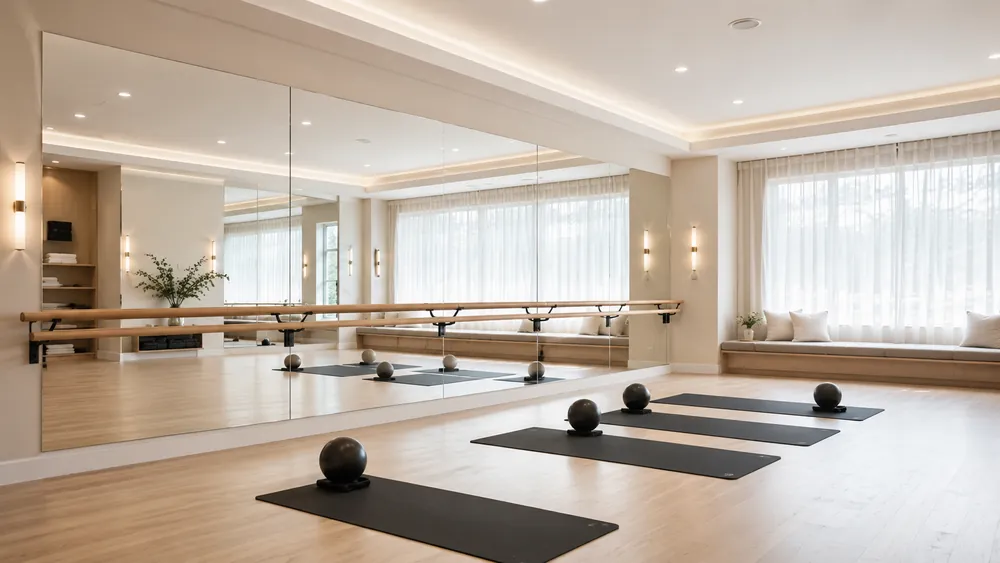
Key points
- Barre combines ballet-inspired movements with Pilates principles and small, high-repetition pulses.
- No dance experience required: the barre is a balance tool, not a ballet technique class.
- Low-impact and beginner-accessible; particularly good for legs, glutes, and core.
- Distinct from Pilates: Pilates trains deep stabilisers through slow control; barre works surface muscles through repetition.
What is barre?
Barre is a fitness format that uses a ballet barre (or a chair or wall) for balance support and builds a workout from small, precise movements drawn from ballet, Pilates, and yoga. The signature element is the "pulse": a tiny, repeated movement at the end of your range that keeps a muscle under sustained tension without moving through a large arc.
The format was developed in the 1950s by Lotte Berk, a German dancer who blended her ballet training with rehabilitation exercises, per the Wikipedia history of the barre workout. From there it spread through various teachers and studios over decades, and the versions you see in Australian studios today range from classical Berk-lineage approaches to more eclectic formats that mix in Pilates apparatus, bands, and light weights.
What a barre class actually involves
A typical 55-minute barre class works through a sequence of sections, each targeting a specific muscle group, with brief recovery between. The order varies by studio, but the shape is consistent.
Most classes open with a warm-up that includes arm work using light weights, activating the shoulders and upper back; many barre studios build this in deliberately, because it addresses muscles that ballet-only formats underserve. From there you move to the long barre section itself, standing beside the rail through pliés, relevés (rising onto the balls of the feet), and positions that load the outer hip and inner thigh. The small-range movements and high repetitions here are the signature experience, and they are where the burn lands. The class then drops to floor work on a mat, targeting the core and seat through Pilates-influenced moves like bridging, leg circles, and curl variations, before finishing on a stretch that usually draws on yoga-informed shapes.
The class is almost universally low-impact. There is no jumping and the floor-based sections have minimal joint load. That is the quality that makes it accessible to beginners and to people returning after injury.
How barre compares to Pilates
Barre and Pilates both borrow from ballet and emphasise body awareness and control, but they train different things. They complement each other well, which is why many practitioners do both.
| Factor | Barre | Pilates |
|---|---|---|
| Primary muscle target | Surface muscles: glutes, quads, inner thighs, shoulders | Deep stabilisers: transversus abdominis, multifidus, pelvic floor |
| Method | Small pulses, high repetition, sustained tension | Slow, precise, controlled movement; low repetition |
| Equipment | Barre, mat, light weights, resistance bands | Mat, or reformer/apparatus |
| Cardio element | More: pace keeps heart rate elevated | Less: focus is control and precision over cardio |
| Cost per class | Typically $25–$40 casual | $20–$35 mat / $35–$60 reformer casual |
| Best for | Legs, glutes, endurance, calorie burn, variety | Core strength, posture, spinal health, rehab |
Who barre suits
Barre suits people who want a low-impact lower-body workout with a cardio element, who find typical gym classes or yoga too slow or too fast respectively, and who want something that genuinely challenges the legs and glutes without high-impact movement.
It particularly suits people returning from injury who need low-impact loading, people who enjoyed dance earlier in their lives and want that kind of movement back in a fitness context, and beginners who find the precise technique demands of Pilates or the flow of vinyasa yoga overwhelming.
It suits less well anyone who is specifically looking for core stabiliser training (Pilates is more direct for that), anyone wanting a high-intensity cardiovascular workout (the pulse-based format raises heart rate but not as high as a power yoga or interval class), and anyone whose injury specifically affects the knee, hip, or foot loading positions that barre places sustained work on.
What to wear and what to bring
Grip socks are standard at barre studios: on a smooth floor, bare feet or regular socks slide, and that is a genuine safety issue during the small, precise movements at the barre. Most studios sell pairs at the desk if you forget, typically $15 to $25. For a detailed run-through of what to wear across Pilates, yoga, and barre, our guide on what to wear covers the specifics.
Light weights are sometimes provided and sometimes asked of you as you progress. Studios that require you to own kit will specify this in their communications. For a first class, bring nothing except the socks: the studio provides everything else.
What it costs in Australia
Casual barre classes in Australia typically run $25 to $40. They sit above mat Pilates and yoga at the lower end because of the smaller class sizes and the boutique positioning most barre studios occupy. Class packs of 5 or 10 usually work out cheaper per class than paying casually, and a two-week unlimited intro offer, commonly around $50 to $80, is the low-risk way to test a studio before you commit.
Unlimited monthly memberships at barre studios tend to sit around $180 to $260 a month, closer to the yoga tier than the reformer Pilates tier because no expensive machines are required. These are 2026 typical ranges that vary by studio and city, and our Pilates cost guide breaks down how packs, memberships, and intro offers actually compare if you want to work out the cheapest option for how often you train. Check the studio directly for current pricing.
Is barre safe?
For most healthy adults, yes. The low-impact format and the absence of jumping or heavy loading make barre one of the more accessible studio formats. Most first-timers adapt quickly within the first two or three classes.
A few situations warrant a check with your physiotherapist or GP first. Knee conditions, hip replacements, significant foot or ankle injuries, and any condition that affects balance or lower-limb stability are worth raising with a professional before you start. Pregnancy is also worth flagging to the studio: many barre exercises can be adapted, and some instructors have specific experience with prenatal modifications, but you should check what the specific studio offers.
This guide is general information only and is not medical advice. For anything specific to your body or condition, your GP or an allied health professional is the right first call.
How to find a barre class
Most Australian capital cities have at least a handful of dedicated barre studios, and hybrid studios that run barre alongside Pilates and yoga are common. You can browse barre studios near you on Studio Finder, or search by suburb and filter for barre-specific classes.
Intro offers are the standard low-risk way to try: two weeks unlimited for $50 to $80 gives you enough time to hit three or four classes and decide if the format suits you before committing to a membership or a class pack.
Barre Explained: common questions
- Do I need a dance background to do barre?
No. The barre is a balance tool, not a dance technique requirement. Classes assume no prior ballet or dance experience, and the movements are explained from first principles. The "ballet-inspired" description refers to posture and small-movement principles, not to the technique or vocabulary of dance training.
- Is barre better than Pilates?
They train different things. Barre focuses on the surface muscles of the lower body and shoulders through small, high-repetition movements. Pilates trains the deep stabilising muscles of the core and spine through slow, precise control. Neither is better overall. They complement each other, and many people do both.
- Why do your legs shake so much in barre?
The small, sustained, high-repetition movements keep a muscle under continuous tension until it fatigues. The shaking is your muscle fibres being recruited in turn as earlier ones tire, which is the specific adaptation the format is designed to produce, not a sign that something is wrong. It passes as your body adapts over the first several classes.
- Is barre good for weight loss?
Barre is a legitimate calorie-burning workout relative to rest, and it builds muscle endurance in the legs and glutes. Weight change is driven by overall activity, nutrition, and consistency rather than any single class format. Treat barre as a useful part of an active lifestyle rather than a weight-loss tool in isolation.
- How often should I do barre to see results?
Two to three sessions a week is a common starting point for building endurance and noticing a difference in the target muscles. Once a week tends to maintain rather than build. The shaking-into-a-muscle feeling is the work, and it takes consistent repetition over weeks to translate into lasting strength.
Ready to find a studio?
Compare barre studios across Australia. Filter by location, read real reviews, and enquire direct.