Key points
- Yoga reliably improves flexibility: government health sources and a 12-week trial registered on the Australian and New Zealand clinical trials registry both support this.
- Real, durable gains take weeks to months of consistent practice; the first session's ease is partly nervous system settling.
- Flexibility is specific to each joint: you can have loose hamstrings and tight shoulders simultaneously.
- Stalled range after two consistent months, or range that comes with pain, is worth a physiotherapist's assessment.
Does yoga actually make you more flexible?
Yes, and this is one of yoga's better-supported benefits. healthdirect, the national health service, lists flexibility among the main reasons people take up yoga and Pilates, and the Better Health Channel says the gentle stretching releases muscle and joint tension and stiffness, and also increases flexibility. The mechanism is plain: you move joints through their full range and hold lengthened positions, and over weeks that range tends to grow.
There is trial evidence too, not just claims. A 12-week Hatha yoga study of 173 adults (average age 52), registered with the Australian New Zealand Clinical Trials Registry, found the yoga group made significant improvements in lower-back and hamstring flexibility on a sit-and-reach test compared with a control group who didn't practise, in both men and women. Attendance was high and no serious adverse events occurred. That is a single trial, in one population, so treat it as supportive rather than the last word. But it lines up with what the government health pages say and with what most people find on the mat: stick at it and you loosen up.
The honest part most studios skip: flexibility is specific. You can get noticeably looser in your hamstrings and still have stiff shoulders, because each joint and muscle group responds on its own timeline. Progress is rarely even.
How yoga builds flexibility
Holding a stretch is only half of it. Yoga works on flexibility through a few different routes, and they matter for understanding why it sticks better than the hamstring stretches you half-remember from school.
The obvious one is lengthening. Poses like a seated forward fold or a low lunge put muscles into a stretched position and ask you to stay there while you breathe, which over time increases how far the muscle and the surrounding tissue will comfortably go. The less obvious one is your nervous system. A lot of what feels like "tightness" is your body guarding a range it doesn't trust, and slow breathing in a held pose is one way to coax that guard down so you can access range you technically already had. Better Health Channel makes the point that focusing on the breath in a pose acts as a form of meditation that soothes the nervous system, and that calming effect is part of why range opens up during a session.
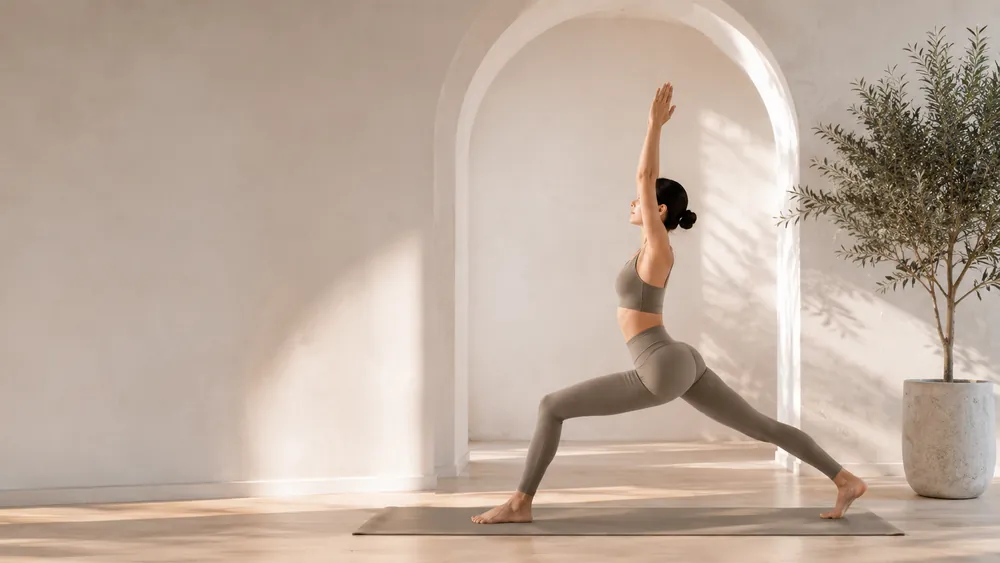
Yoga also builds strength at the end of your range, not just passive stretch. Holding a Warrior pose or a balance asks muscles to work while lengthened, which is more useful for everyday movement than floppy, unsupported flexibility. That blend of mobility and control is the bit a quick stretch routine misses.
How long before you notice a change
Most people feel a little looser within the first few weeks of practising a couple of times a week, often after a single session, though that early ease is partly your nervous system settling rather than lasting change. Real, durable gains in range take longer, usually a couple of months of consistent practice, and they keep coming for as long as you keep showing up.
Frame any number as a rough guide, not a guarantee. The 12-week trial above measured its flexibility gains at the three-month mark, which is a reasonable horizon to judge your own progress against. How fast you move along it depends on things you can't fully control: your starting flexibility, your age, your build, whether a joint has old scar tissue, and how often you practise. Twice a week tends to produce steady change. Once a week tends to maintain. And it fades if you stop, the same as any other training, so the people who stay flexible are the ones who keep a regular practice going rather than chasing a one-off result.
If you have put in two or three consistent months and a particular area hasn't budged at all, that is worth a physiotherapist's read rather than just forcing it harder. Stalled range can be structural, and forcing a stubborn joint is how people get hurt.
Which yoga styles build flexibility best
Most styles improve flexibility, since stretching is baked into nearly all of them, but the pace and feel differ a lot. The best style for you is the one you will actually keep attending, so this is as much about temperament as technique. Slower, held-pose styles tend to be the most direct for flexibility. Yin yoga holds floor poses for minutes at a time to work into deeper tissue, and Hatha (the style used in the 12-week trial) moves at a measured pace with time in each posture. Iyengar uses props and precise alignment, which suits anyone who wants to open up safely without straining. If you prefer movement and a bit of heat, Vinyasa flows pose to pose and builds flexibility alongside strength and cardio, though it gives you less time in each stretch. Our guide to choosing a yoga style walks through the main types and who each suits, and the hot yoga guide covers what the heat does and doesn't do if a warm room appeals.
Whatever you pick, the things that actually drive flexibility are the same: a teacher who watches and adjusts you rather than just demonstrating from the front, a beginner or foundations option so you learn safe positioning, and a schedule you can hit twice a week. Better Health Channel's advice is to find a properly trained and qualified instructor, and you can search registered teachers through Yoga Australia.
| Style | Hold length | Best for flexibility | Notes |
|---|---|---|---|
| Yin | 3 to 20 min | Deep connective tissue and joint range | Most direct for flexibility; some intensity in holds |
| Hatha | 30 sec to a few breaths | General flexibility at a measured pace | Suits beginners; clear instruction |
| Iyengar | 30 sec to several minutes | Safe opening with precise alignment | Props used extensively; suits bodies that need careful positioning |
| Vinyasa | 1 to 5 breaths | Flexibility alongside strength and cardio | Less time per stretch; good overall conditioning |
| Restorative | 5 to 20 min | Passive opening through supported holds | No effort required; very gentle; suits recovery |
When tightness is a job for a physio first
Yoga is a reasonable choice if your goal is general: you feel stiff, you want to move more freely, you'd like to touch your toes without it being a project. It is not the right first stop when stiffness comes packaged with pain or a known problem.
See a physiotherapist or your GP before starting if you have:
- Joint or muscle pain that's persistent, sharp, or getting worse, rather than ordinary stiffness.
- A past injury, surgery, or a diagnosed joint condition that hasn't been cleared for exercise.
- Hypermobility, or joints that already feel loose and unstable, where more stretching may not be what you need.
- Numbness, tingling, or pain that radiates down a limb.
- Pain that comes on during or after stretching and doesn't settle.
healthdirect's advice is that if you're new, have an injury or a health condition, it's best to go to a class with a qualified instructor who can adjust the moves, and for anything tied to pain or a diagnosis, a physio's individual assessment beats any group class. Better Health Channel is blunt on the safety point: an asana should never cause pain, and if you feel pain or discomfort you should ease off or skip the pose. It also advises that men over 45, women over 55, anyone who hasn't exercised in a long time, or anyone with a pre-existing condition check with a GP before starting a new routine. A single physio session before you commit is cheap insurance, and a good physio may steer you toward the styles and poses that suit your body.
What it costs to try
Most yoga studios run an intro offer, which is the most honest way to test whether a style and a teacher suit you before committing. These tend to run around $45 to $80 for two weeks unlimited across Australia, though it varies by studio and city. A casual drop-in class is usually somewhere around $20 to $35. Unlimited monthly memberships for yoga commonly sit around $180 to $280, which only makes sense once you're going several times a week. Class packs typically shave roughly 15 to 25% off the casual rate. Treat all of these as rough 2026 norms and check the studio's actual prices, since they move around a lot.
You can compare studios, styles, and prices in your area on Studio Finder's yoga listings, or search beginner-friendly classes if you're starting from scratch.
This guide is general information only and is not medical advice. See your GP or an allied health professional for advice about your own situation.
Yoga for Flexibility: common questions
- How long does it take to get flexible with yoga?
Most people feel looser within the first few weeks of practising twice a week, with lasting gains in range usually building over a couple of months. A 12-week trial registered on the Australian and New Zealand clinical trials registry measured significant flexibility improvements at the three-month mark. Your pace depends on your starting point, your body, and how consistently you practise, so treat any timeline as a guide rather than a promise.
- Can yoga make anyone do the splits?
Not necessarily, and it's the wrong goal for most people. Flexibility is specific to each joint and limited by your individual anatomy, so how far you can go varies a lot from person to person. Yoga reliably increases your usable range over time, but a deep split or backbend isn't guaranteed for every body, and chasing one is a common way to get injured.
- Is it normal to feel sore or tight after yoga?
Mild muscle soreness in the day or two after a session can be normal, the same as any new exercise. Sharp or joint pain is not. Better Health Channel says a pose should never cause pain, so ease off anything that hurts and tell your teacher. Pain that radiates, lingers, or follows an old injury is a reason to see a physiotherapist.
- Which yoga style is best for flexibility?
Slower, held-pose styles like Yin, Hatha, and Iyengar give you the most time working into each stretch, which suits a flexibility focus. Vinyasa builds flexibility alongside strength and cardio but moves faster. The style you'll keep attending beats the "optimal" one you quit. See our guide to yoga styles to compare.
- Do I need to be flexible to start yoga?
No. Starting stiff is normal and instructors adjust poses to suit all levels. healthdirect notes that beginners, or anyone with an injury or health condition, should start with a qualified instructor who can guide safe positioning. You build flexibility through practising, not before it.
Ready to find a studio?
Compare yoga studios across Australia. Filter by location, read real reviews, and enquire direct.